
What is Amazon AI?
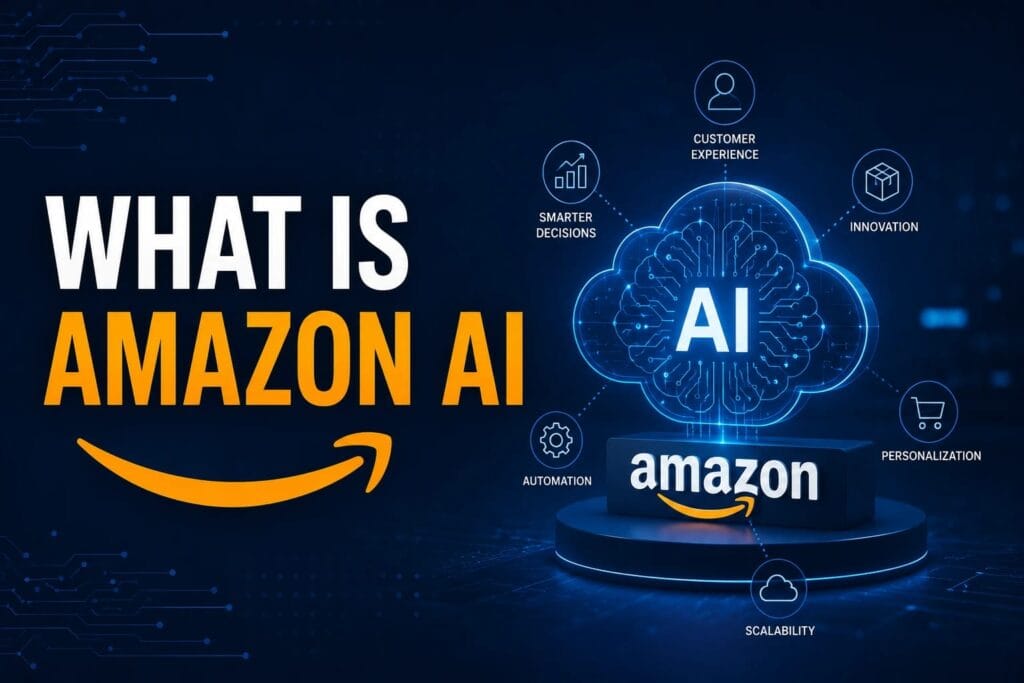
Amazon AI refers to the broad collection of Artificial Intelligence and Machine Learning technologies developed by Amazon, mainly delivered through Amazon Web Services (AWS). It includes powerful tools such as Amazon SageMaker for building and deploying custom machine learning models, Amazon Bedrock for generative AI and foundation models, Amazon Q (an intelligent AI assistant), and specialized services like Amazon Rekognition (image and video analysis), Amazon Transcribe (speech-to-text), Amazon Comprehend (natural language processing), and Amazon Personalize (recommendation engines).
Amazon has been investing in AI for more than 25 years, using it internally to power product recommendations, supply chain optimization, Alexa voice assistant, and warehouse robotics, while also making these advanced capabilities available to businesses and developers worldwide.
Role of AI in Modern Technology In today’s world, Artificial Intelligence plays a central and transformative role. It enables machines to perform tasks that typically require human intelligence, such as learning from data, recognizing patterns, making predictions, understanding language, generating content, and making autonomous decisions.
AI powers personalized experiences (like Netflix or Amazon recommendations), automates repetitive work, extracts insights from massive datasets, and drives innovations in computer vision, robotics, and generative applications. It is fundamentally reshaping industries including retail, healthcare, finance, logistics, manufacturing, and entertainment by increasing efficiency, reducing costs, improving customer satisfaction, and enabling new products and services that were not possible before.
Why is Amazon AI Important? Amazon AI is important because it provides accessible, scalable, secure, and enterprise-ready AI tools to organizations of all sizes. Companies can integrate cutting-edge AI capabilities without building complex infrastructure from scratch. Backed by Amazon’s real-world experience running the world’s largest e-commerce platform and cloud infrastructure, its AI solutions are highly practical and proven at massive global scale.
From optimizing deliveries and inventory to creating smarter shopping experiences (such as Rufus AI assistant), Amazon AI helps businesses reduce costs, increase revenue, and stay competitive. As AI continues to grow rapidly, Amazon’s heavy investments in data centers, custom chips (like Trainium and Inferentia), and advanced models make it one of the leading platforms driving responsible and impactful artificial intelligence across the globe.
In summary, Amazon AI is a practical and powerful engine that is shaping the future of business and everyday technology.
The History of Amazon AI
Amazon began its journey with Artificial Intelligence in the late 1990s, almost from the very beginning of the company. Even as a young online bookstore, Amazon recognized the power of data to personalize the shopping experience. By the late 1990s, it moved beyond manual recommendations to algorithmic systems.
Early AI Projects Amazon’s first major AI application was its recommendation engine. In the mid-to-late 1990s, the company experimented with collaborative filtering. By 1998–1999, it deployed item-to-item collaborative filtering — a groundbreaking approach at the time.
This system analyzed customer purchases and browsing behavior to suggest relevant products. The 2003 IEEE paper on this technology later received a Test of Time award, highlighting its lasting impact. These early systems drove a significant portion of Amazon’s sales and laid the foundation for modern personalization.
Alexa and Recommendation System The recommendation system continued to evolve, becoming more sophisticated with machine learning and powering features across search, cart, and checkout. In 2014, Amazon made a major leap into consumer AI with the launch of Alexa and the Echo smart speaker on November 6, 2014.
Inspired by the Star Trek computer, Alexa introduced voice interaction powered by natural language processing and machine learning. It started as a smart speaker for music and queries but quickly expanded into smart home control, shopping, and skills developed by third parties.
Over the next decade, Amazon invested heavily in AWS AI services like SageMaker (2017), Bedrock, and custom chips. Today, AI powers everything from supply chain optimization to robotics and generative applications, making Amazon one of the most experienced AI companies in the world.
Amazon AI vs Google AI vs Microsoft AI
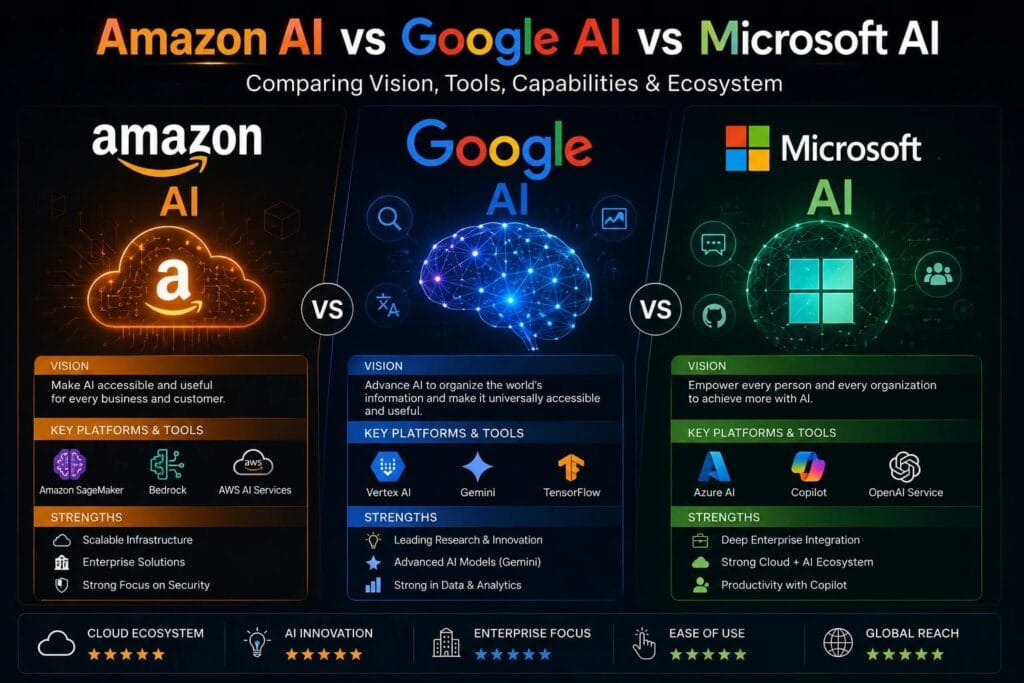
Amazon AI, Google AI, and Microsoft AI are the three leading forces in the artificial intelligence landscape. Each excels in different areas, offering unique strengths for consumers and businesses.
Comparison Table
| Features | Amazon AI | Google AI | Microsoft AI |
|---|---|---|---|
| Cloud AI | AWS + Bedrock (most neutral, wide model choice) | Vertex AI + Gemini (strongest growth & multimodal) | Azure AI + OpenAI (best enterprise integration) |
| Voice AI | Alexa (best for smart homes & devices) | Google Assistant / Gemini (best knowledge & search) | Copilot (best for productivity & work) |
| Generative AI | Bedrock + Amazon Nova (high flexibility, good price-performance) | Gemini (strongest native intelligence & creativity) | Azure OpenAI + Copilot (deepest business workflow integration) |
| Business Use | E-commerce, logistics, scalable infrastructure | Data analytics, AI-native apps, search | Office 365, enterprise productivity, compliance |
Amazon AI stands out for its practical, large-scale applications. It powers shopping experiences, logistics, and recommendation engines. Amazon Bedrock offers excellent model variety (Claude, Llama, Titan, etc.) with strong security and governance, making it ideal for enterprises that value flexibility and reliability.
Google AI leads in raw AI innovation and performance. With Gemini models and Vertex AI, it excels in multimodal capabilities, data analytics (BigQuery), and fast-growing AI infrastructure. It is preferred for cutting-edge research and applications requiring deep intelligence.
Microsoft AI dominates enterprise adoption. Through deep integration with OpenAI and Copilot, it seamlessly embeds AI into tools people already use — Word, Excel, Teams, and Power Platform. It is the go-to choice for businesses focused on productivity and compliance.
In summary, choose Amazon AI for scalable operations and e-commerce, Google AI for advanced model performance, and Microsoft AI for workplace productivity. Many large organizations use all three depending on specific needs.
How Amazon Uses Artificial Intelligence
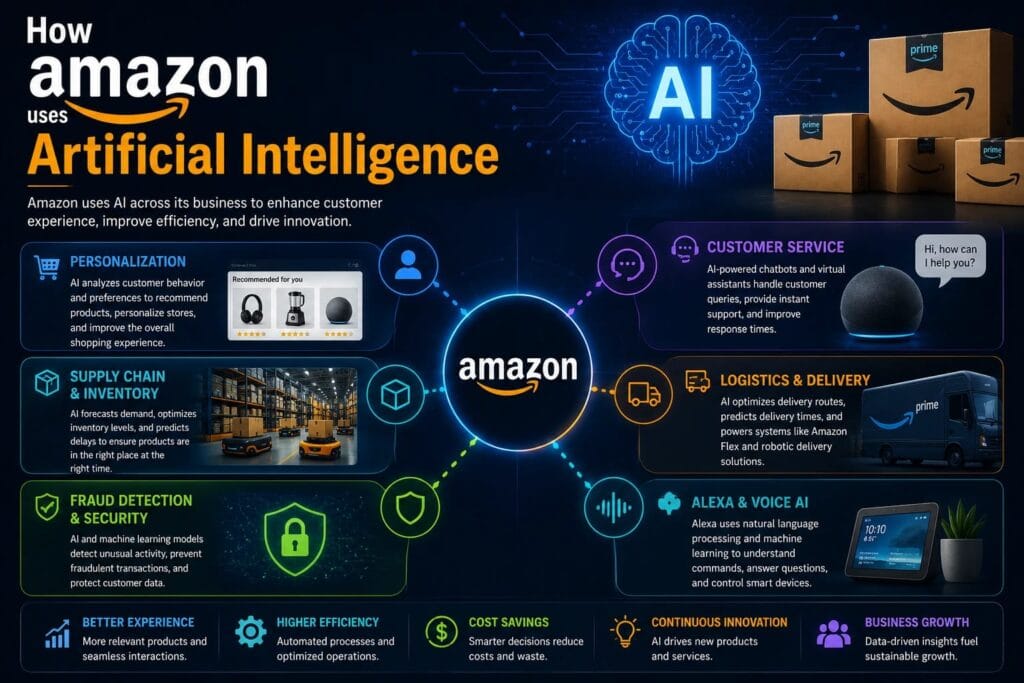
Amazon extensively integrates Artificial Intelligence across its operations to enhance customer experience, optimize efficiency, and drive innovation at scale.
AI in Amazon Shopping
Amazon uses AI to make shopping more intuitive and personalized. The company’s generative AI-powered shopping assistant (currently Alexa for Shopping, evolved from Rufus) allows customers to ask natural-language questions, compare products, get styling advice, and receive personalized recommendations. AI also powers features like Interests, which notifies users about new products, restocks, and deals matching their preferences. AI-generated review summaries and contextual search further help customers make faster, more informed buying decisions.
AI in Product Recommendations
Product recommendations remain one of Amazon’s earliest and most successful AI applications. Using machine learning algorithms like item-to-item collaborative filtering, Amazon analyzes browsing history, purchases, and behavior to suggest relevant products. These systems power “Frequently Bought Together,” “Customers Also Bought,” and personalized homepages, significantly driving sales. Advanced models now deliver hyper-personalized recommendations in real time.
AI in Customer Support
Amazon leverages AI to provide fast and efficient customer service. AI-powered chatbots and virtual assistants handle routine queries, order tracking, returns, and refunds 24/7. Tools like Amazon Q in Connect and Contact Lens offer real-time agent assistance, conversation summaries, sentiment analysis, and personalized responses. Generative AI helps resolve issues quicker while improving overall customer satisfaction and reducing wait times.
AI in Delivery & Logistics
AI is central to Amazon’s world-class logistics network. Predictive analytics forecast demand, optimize inventory placement, and anticipate customer needs. Machine learning powers intelligent route optimization, considering traffic, weather, and package details for faster deliveries. In warehouses, over one million AI-powered robots handle picking, sorting, packing, and stowing, working alongside humans to boost efficiency. Technologies like the Package Decision Engine optimize packaging, while agentic AI systems improve operational decision-making.
Through these applications, Amazon demonstrates how AI creates a seamless, efficient, and customer-centric ecosystem.
Amazon Alexa and Voice AI Technology
Amazon Alexa is one of the most successful and widely adopted voice AI technologies in the world. Launched in November 2014 with the Echo smart speaker, Alexa started as a cloud-based voice assistant inspired by the Star Trek computer. It quickly evolved into a powerful platform that understands natural language and performs thousands of tasks.
Alexa ka Role (Role of Alexa)
Alexa serves as a versatile personal assistant and smart home controller. It plays music, answers questions, sets reminders, reads news, makes calls, and orders products from Amazon. With over 600 million devices worldwide, Alexa processes billions of requests annually. The latest upgrade, Alexa+ (launched in 2025 and widely rolled out in 2026), uses generative AI to make interactions more conversational, contextual, and proactive. It remembers user preferences, handles complex multi-step requests, maintains conversation threads, and performs agentic tasks like booking reservations or managing schedules.
Smart Homes
Alexa is a leader in smart home automation. It acts as a central hub supporting thousands of devices from hundreds of brands, including lights, thermostats, cameras, locks, and appliances via Zigbee, Matter, and Thread protocols. Users can control their entire home with simple voice commands — for example, “Alexa, good night” to turn off lights, lock doors, and adjust the thermostat. Newer Echo devices with advanced sensors enable ambient intelligence, offering proactive assistance based on who is in the room or what is happening in the home.
Voice Assistants ka Future
The future of voice assistants like Alexa lies in multimodal, proactive, and deeply personalized AI. Alexa+ is moving beyond simple commands toward natural conversations, long-term memory, and integration across web, mobile, vehicles, and wearables.
Future developments will focus on agentic capabilities (autonomously completing tasks), better privacy controls, emotional intelligence, and seamless blending into daily life as an ambient companion. As voice AI grows, it will become even more central to smart homes, healthcare, education, and commerce.
Alexa has transformed how millions interact with technology and continues to lead the evolution of voice
Amazon Web Services (AWS) and AI Tools
Amazon Web Services (AWS) is the backbone of Amazon AI, offering a comprehensive suite of cloud-based artificial intelligence and machine learning tools. AWS enables businesses and developers to build, train, deploy, and scale AI applications securely and efficiently without managing complex infrastructure.
Amazon Bedrock
Amazon Bedrock is a fully managed service that provides easy access to high-performing foundation models from leading providers such as Anthropic (Claude), OpenAI (GPT models), Meta (Llama), Mistral, and Amazon’s own Nova and Titan models.
It allows users to build and scale generative AI applications and agents through a single API, with built-in enterprise security, privacy, and governance. Key capabilities include model customization, knowledge bases, Guardrails for safety, and AgentCore for building production-ready autonomous agents. Bedrock is widely used for chatbots, content generation, summarization, and complex workflows.
Amazon SageMaker
Amazon SageMaker is AWS’s flagship platform for building, training, and deploying custom machine learning models at any scale. It offers a complete set of tools for the entire ML lifecycle, including data preparation, model training, experimentation, and monitoring. Recent advancements include agentic experiences for faster model customization, SageMaker HyperPod for high-performance training of large models, and integration with coding agents. SageMaker supports both traditional ML and foundation models, making it ideal for enterprises that need full control and customization.
AI Cloud Services
AWS provides a rich collection of ready-to-use Amazon AI cloud services that add intelligence to applications with minimal effort. These include Amazon Rekognition for image and video analysis, Amazon Comprehend for natural language processing, Amazon Transcribe for speech-to-text, Amazon Polly for text-to-speech, and Amazon Lex for conversational interfaces. These fully managed services power features like facial recognition, sentiment analysis, document processing, and intelligent chatbots across industries.
Machine Learning Tools
Beyond core platforms, AWS offers specialized machine learning tools such as Amazon Personalize for recommendation systems, Amazon Forecast for time-series predictions, and Amazon Q for generative AI assistance in development and operations. Custom infrastructure tools like AWS Deep Learning AMIs, optimized containers, and purpose-built chips (Trainium and Inferentia) further enhance performance and cost-efficiency.
Together, these Amazon AI tools on AWS make advanced artificial intelligence accessible, scalable, and secure for organizations of all sizes.
Amazon Generative AI Explained
Generative AI kya hoti hai? Generative AI is a type of artificial intelligence that can create new and original content such as text, images, videos, code, music, and conversations. Unlike traditional AI that only analyzes or classifies data, generative AI learns patterns from massive datasets and generates human-like outputs based on user prompts. It powers tools like ChatGPT and is transforming how businesses create content, automate tasks, and interact with customers.
Amazon ka Generative AI System Amazon AI has built a strong generative AI ecosystem centered on Amazon Bedrock and its own family of foundation models, particularly Amazon Nova. Nova offers frontier-level intelligence with excellent price-performance across text, vision, video, and multimodal capabilities.
Through Bedrock, users can access Amazon Nova, Titan models, and leading third-party models (Claude, Llama, etc.) in a fully managed, secure environment. This allows businesses to build custom generative applications, fine-tune models with private data, and deploy production-ready AI agents with strong governance and safety features.
Chatbots aur AI Content Tools Amazon AI powers several practical generative tools. Amazon Rufus (now evolved into Alexa for Shopping) is a generative AI shopping assistant that answers complex queries, compares products, and provides personalized recommendations.
Amazon Q serves as a powerful generative AI assistant for developers, business users, and contact centers — helping with code generation, data analysis, and customer support. Other tools enable AI-generated product descriptions, review summaries, image generation, video creation for sellers, and intelligent chatbots. These solutions combine generative capabilities with Amazon’s vast e-commerce and cloud data for highly relevant, real-time results.
In short, Amazon AI makes generative AI accessible, secure, and scalable for real-world business impact.
Benefits of Amazon AI
Amazon AI delivers powerful advantages across shopping, operations, and security, making everyday experiences smoother and more intelligent.
Faster Shopping Experience
Amazon AI significantly speeds up the entire shopping journey. With generative AI assistants like Rufus and Alexa, customers can ask natural questions, get instant product comparisons, and complete purchases faster. AI-powered search understands intent better, while smart features such as one-click ordering, visual search, and real-time availability checks reduce time spent browsing. Amazon AI makes shopping quick, convenient, and effortless.
Better Recommendations
One of the strongest benefits of Amazon AI is its highly accurate product recommendations. Using advanced machine learning, Amazon AI analyzes browsing history, purchases, and preferences to suggest relevant items. Features like “Frequently Bought Together” and personalized homepages are powered by Amazon AI, helping customers discover products they truly love and increasing satisfaction.
Improved Security
Amazon AI strengthens security and fraud prevention. Machine learning models detect suspicious activities, fake reviews, and fraudulent accounts in real time. Amazon Rekognition and other Amazon AI tools verify identities, monitor transactions, and protect customer data, creating a safer shopping environment for millions of users.
Automation
Amazon AI drives massive operational automation. In warehouses, AI-powered robots handle picking, packing, and sorting efficiently. Amazon AI also automates inventory management, demand forecasting, delivery route optimization, and customer support through intelligent chatbots. This results in faster deliveries, lower costs, and consistent service quality.
Overall, Amazon AI creates a smarter, safer, and more efficient ecosystem for both customers and the business.
The Future of Amazon AI in 2026 and Beyond
Amazon is heavily investing in Amazon AI, with plans for approximately $200 billion in capital expenditure in 2026, focused primarily on AI infrastructure, data centers, and custom chips. The company aims to double its power capacity by the end of 2027, positioning itself as a leader in the next phase of artificial intelligence.
Future Predictions
By 2027–2028, Amazon AI is expected to deliver massive returns through agentic AI systems that can autonomously plan and execute complex tasks. Amazon Nova 2 models (Lite, Pro, and multimodal) will power frontier-level intelligence with superior price-performance. Amazon AI will expand deeply into enterprise applications, with strong revenue growth from AWS AI services already exceeding $15 billion annual run rate.
AI Shopping
Amazon AI will transform shopping with Alexa for Shopping — the evolved, personalized agentic assistant combining Rufus and Alexa+. It will handle natural conversations, remember preferences, compare products, track deals, and complete purchases autonomously. Visual search, generative styling advice, and proactive recommendations will make shopping more intuitive and predictive.
AI Robots
Amazon AI is accelerating robotics with over one million robots already deployed. Future humanoid and advanced manipulation robots (like enhanced Robin, Cardinal, and Proteus) will handle complex picking, packing, and sorting. AI foundation models will train robot fleets for greater dexterity and adaptability.
Smart Warehouses
Next-generation smart warehouses will feature multi-agent AI coordination (Deep Fleet), agentic systems like Project Eluna for real-time decision-making, and highly automated fulfillment centers targeting up to 75% automation. This will enable faster deliveries, lower costs, and optimized inventory with minimal human intervention.
Future AI Assistants
Amazon AI assistants will become proactive, multimodal, and ambient companions — managing schedules, smart homes, health, and work tasks across devices with long-term memory and emotional intelligence. Agentic capabilities will allow them to complete entire workflows independently.
The future of Amazon AI promises more efficient operations, hyper-personalized experiences, and transformative business value.
Raed More: Best Free AI Video Generators 2026: Top Tools Tested for Quality, Limits & No Watermark Options
Final Conclusion
Amazon AI has evolved from early recommendation engines to a comprehensive, powerful artificial intelligence ecosystem. From enhancing the shopping experience with personalized recommendations and generative AI assistants like Alexa and Rufus, to optimizing massive logistics networks and powering smart warehouses, Amazon AI now touches almost every aspect of Amazon’s operations and millions of customers’ daily lives.
Amazon AI delivers real-world value through faster shopping, smarter recommendations, efficient delivery, improved security, and seamless voice experiences. Its cloud platforms — Amazon Bedrock and SageMaker — are making advanced generative AI accessible to businesses worldwide.
Future Impact In 2026 and beyond, Amazon AI is set to revolutionize e-commerce, robotics, and enterprise operations. Agentic AI systems, advanced humanoid robots, and proactive AI assistants will create more autonomous, intuitive, and efficient experiences than ever before.
Amazon AI is transforming the way people shop, work, and live with technology. As artificial intelligence continues to advance, Amazon’s deep expertise and massive scale position it as one of the most influential players shaping our AI-powered future.
The question is no longer whether AI will change our lives — but how quickly Amazon AI will lead that transformation.
FAQ
Q1: What is Amazon AI? Amazon AI refers to Amazon’s comprehensive suite of Artificial Intelligence and Machine Learning technologies. It powers everything from product recommendations and Alexa voice assistant to advanced cloud services on AWS. Amazon AI includes tools like Amazon Bedrock, SageMaker, and specialized services for computer vision, natural language processing, and generative AI. It helps millions of customers enjoy personalized shopping while enabling businesses to build scalable AI solutions. (62 words)
Q2: How does Amazon use artificial intelligence? Amazon AI is deeply integrated across its operations. It powers personalized product recommendations, smart search, generative shopping assistants (like Rufus/Alexa), fraud detection, and customer support chatbots. In logistics, Amazon AI optimizes delivery routes, manages inventory, and controls over a million warehouse robots. It also enhances security and automates processes in smart warehouses, making operations faster, cheaper, and more efficient. (58 words)
Q3: Is Amazon AI free to use? Amazon AI is not entirely free. Many consumer features (recommendations, basic Alexa, Rufus) are free for Amazon customers. However, AWS AI services like Amazon Bedrock and SageMaker follow a pay-as-you-go pricing model. New AWS users get free credits, but heavy usage incurs charges based on models, tokens, and compute. Some services offer free tiers with limited usage. (64 words)
Q4: What is Amazon Bedrock? Amazon Bedrock is a fully managed AWS service that allows easy access to powerful foundation models from Amazon, Anthropic, Meta, Mistral, and others. It enables developers and businesses to build and scale generative AI applications, chatbots, agents, and custom models with strong security, privacy, and governance features. Bedrock is one of the most important parts of Amazon AI for enterprises. (66 words)
Q5: Can Amazon AI replace human jobs? Amazon AI automates repetitive and physically demanding tasks, especially in warehouses, which may reduce the need for certain roles. However, it also creates new jobs in AI development, robotics maintenance, data analysis, and system management. Amazon emphasizes reskilling its workforce. While Amazon AI increases efficiency and may displace some positions, it is more about augmenting human capabilities than complete replacement.
🙏