
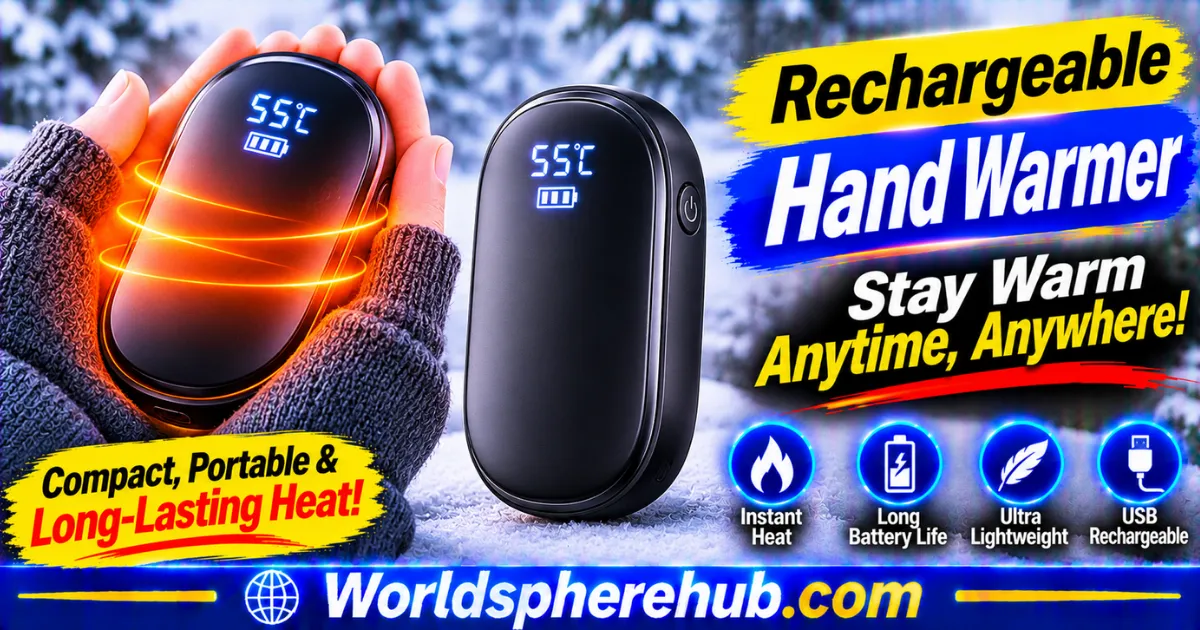
Rechargeable Hand Warmer Review: Key Features
SHORT DIRECT ANSWER
A rechargeable hand warmer uses a lithium battery and a heating element to keep hands warm without disposable packets. Many models offer multiple heat settings, dual-sided heat, and power bank charging for phones. Compare battery capacity, runtime, temperature range, safety features, and charging port before choosing one.
Rechargeable Hand Warmer Types at a Glance
The table below shows the main styles you will find.
| Type | How It Works | Best For | Typical Trade-Off |
|---|---|---|---|
| Pocket-size USB warmer | Rechargeable lithium battery | Commuting, errands, sports | Limited runtime on high heat |
| Warmer with power bank | Larger battery that also charges devices | Travel, camping, phone backup | Heavier and bulkier |
| Magnetic paired warmers | Two units that can snap together | Couples, ski trips, outdoor use | Two items to charge |
| Hand muff or pouch style | Warmer inside a fabric pouch | Hunting, standing outdoors | Less pocketable |
| Refillable fuel warmer | Lighter fluid, not battery | Long cold days, no charging | Different fuel and maintenance |
How a Rechargeable Hand Warmer Works
Inside the case is a lithium battery, a control circuit, and a heating element. When you press the button, current flows through the element and warms the surface. A temperature control chip regulates the heat, and most models have several levels so you can choose a comfortable temperature.
Because the battery is the energy source, capacity and heat level decide how long it lasts. Higher heat drains the battery faster, so a warmer might run for many hours on low and far less on high.
Battery Capacity and Runtime
Battery capacity is listed in milliamp hours (mAh). Published buying guides describe a typical range of about 3,000 to 8,000 mAh for rechargeable hand warmers, and that range determines how long and how strongly the device can heat.
What the Numbers Look Like
Product listings show a wide spread. Zippo’s HeatBank 3 uses a 2,600 mAh battery, while its HeatBank 9s uses a 5,200 mAh lithium battery with a rated runtime of up to 9 hours. A Bob Vila guide describes one pick with a 10,000 mAh battery and up to 8 hours on low heat. Another test guide highlights a 9,000 mAh warmer with a 14-hour rating.
Manufacturer runtimes usually describe low heat. If you plan to use high heat, expect a shorter time. Zippo’s own guide notes that heat settings may affect duration.
How Much Do You Need?
For short outings, a smaller 2,000 to 3,000 mAh warmer may be enough. For all-day use, such as skiing, hunting, or working outdoors, a 5,000 mAh or larger model is easier to rely on. One test guide suggests looking for an electric warmer with adjustable heat, a battery indicator, and a battery life of at least six hours.
Heat Settings and Temperature Range
Adjustable heat is one of the best features to look for. It lets you save battery when conditions are mild and increase warmth when you need it.
Typical Levels
The number of settings varies. A market guide notes that many hand warmers offer three to six heat levels. Examples include a Pilot model with two settings, listed at 108°F on low and 117°F on high, and a Zippo HeatBank 9s with six levels and a choice of single-sided or dual-sided heat. One set of magnetic warmers is described with three levels ranging from 95°F to 131°F, and another review lists 104°F, 122°F, and 131°F.
Is Hotter Better?
Not always. A guide to one 10,000 mAh warmer notes that it can feel uncomfortably hot against bare hands when temperature spikes. Others are criticized for inconsistent heat. If you plan to hold the warmer for long periods, pick a model with a gentler low setting and reliable regulation.
Design and Portability
Most hand warmers are slim and pocket-friendly. Zippo describes a curved, ergonomic design for the HeatBank 9s, and a UK review lists dimensions around 20 by 15 centimeters for a larger model. Smaller 2,000 to 3,000 mAh units are closer to the size of a deck of cards.
Single-Sided and Dual-Sided Heat
Some warmers heat one side, while others heat both sides. Dual-sided heat helps when you hold the warmer in one hand and want warmth on both palm and fingertips. It also uses more power, so check the runtime for the mode you plan to use.
Straps, Lanyards, and Magnets
Practical extras make a difference outdoors. Some models include a neck lanyard, and others offer rubber straps that attach to backpacks. Magnetic pairs, such as Ocoopa’s UT3 style, can snap together for easy storage. If you wear gloves, look for a warmer that is easy to grip.
Power Bank Function
Many rechargeable hand warmers double as power banks. Listings often show a USB output that lets you charge a phone, camera, or other small device.
How It Helps
For travelers, this is a real advantage. A hand warmer that can top up a phone saves you from carrying a separate battery. One Canadian Tire listing for a 5,200 mAh model says it can charge a phone up to three times, though real results depend on the phone.
The Catch
Heating and charging at the same time drain the battery quickly. Zippo’s guide notes that when a mobile device is charging, the hand warmer’s heat function is disabled to prevent overheating. Remove the cable to resume heating. If you rely on the warmer for heat, use the power bank feature sparingly.
Charging and Connectivity
Charging convenience matters, since you will do it often.
USB-C and Micro-USB
Many newer warmers use USB-C charging, such as Ocoopa and Fandliss models, which is easy to share with phones and tablets. Older models still use micro-USB. A buying guide points out that one warmer is held back by its older micro-USB port compared with USB-C competitors.
Charging Time and Habits
Charging times depend on battery size and the charger. Some models offer an auto-charging feature, and others rely on the included cable. Charge the warmer before you leave home, and consider carrying a power bank on multi-day trips.
Safety Features
Because these devices generate heat, safety features are essential.
What to Look For
A market overview says overheat protection and automatic shutoff are now standard on many models. One review highlights a warmer with a temperature control chip, a heat-resistant casing, and a UL-certified lithium battery, along with protection against overvoltage, overload, overcharge, and short circuits. A Canadian Tire listing mentions automatic shutoff, overload protection, a battery test function, and indicator lights.
Safe Use Tips
Do not place a hand warmer against bare skin for long periods at high heat. People with reduced sensation in their hands should be especially careful, since they may not notice a burn. Avoid sleeping with a warmer, and do not cover it in a way that traps heat. Follow the manual, and stop using a device that smells odd, swells, or overheats.
Water and Dust Resistance
Most hand warmers are not designed for water. One test roundup highlights a model with an IP45 rating that offers protection against dust and splashes, which is useful for ski days or wet weather. Do not submerge any rechargeable warmer, and keep it dry when you can.
Special Features Worth Noting
- Battery indicator lights or LCD to track remaining power
- Low battery warning so you are not caught off guard
- Built-in flashlight on some models, including an SOS mode
- Dual-sided heat for fuller warmth
- Magnetic pairs that snap together
- Carry pouches or lanyards for convenience
Benefits and Limitations
| Benefits | Limitations |
|---|---|
| Reusable, with no disposable packets | Battery runtime has limits |
| Adjustable heat on many models | Heat can be inconsistent on some |
| Doubles as a power bank | Heat stops while charging devices on some models |
| Easy USB charging | Older models use micro-USB |
| Compact and pocket-friendly | Not waterproof on most models |
Who Should Buy a Rechargeable Hand Warmer?
Commuters, skiers, hunters, hikers, sports spectators, and outdoor workers all get real value from one. It is also useful for people who feel the cold in their hands more than others, and it makes a practical gift for winter.
It may be less ideal if you need warmth for several days without power access, or if you want a very small, lightweight option. In that case, disposable warmers or a refillable fuel warmer may be easier to manage.
How to Choose the Right One
Start with how you will use it. For short daily trips, a smaller warmer is enough. For long outdoor days, choose higher capacity and multiple heat settings. Check the charging port, safety features, and the runtime on the heat level you plan to use. If you want power bank features, confirm the output and how the heat works while charging.
Frequently Asked Questions
1: How long does a rechargeable hand warmer last?
It depends on battery size and heat level. Published specs range from about 2 to 14 hours. Runtimes are usually listed for low heat, so expect less on high settings.
2: Can a rechargeable hand warmer charge my phone?
Many can. Several models include a USB output and double as a power bank. Some disable heating while charging another device, so check the manual.
3: Is a rechargeable hand warmer safe to hold?
Most reputable models include overheat protection and automatic shutoff. Still, avoid prolonged contact with skin at high heat, and take extra care if your hands have reduced sensation.
4: What mAh battery should I choose?
For daily errands, a smaller battery may work. For all-day outdoor use, 5,000 mAh or higher is a common choice. Capacity helps, but efficiency and heat setting also matter.
5: Are rechargeable hand warmers better than disposable ones?
They can be more convenient and reusable, which helps reduce waste. Disposables need no charging, so they can be easier for multi-day trips without power access.
Explore More Continue Reading Our Guide on: Portable DVD Player Review: Features & Travel
Bluetooth Keyboard Review: Features & Comfort
Wireless Charging Pad: Qi2 Speed, Cases, Tips
USB-C Charger Buying Guide: Wattage Made Easy
Wireless HDMI Transmitter: Ditch Cables Today
Aura Digital Picture Frame Review: Full Guide
Portable Photo Printer Review: Features Guide
Conclusion
A rechargeable hand warmer offers reusable heat, adjustable temperatures, long battery life, and power bank convenience on many models. Limitations include runtime limits, heat inconsistency, charging needs, and safety precautions, so always choose capacity and safety features carefully before buying.




2 Comments