
Quick Answer
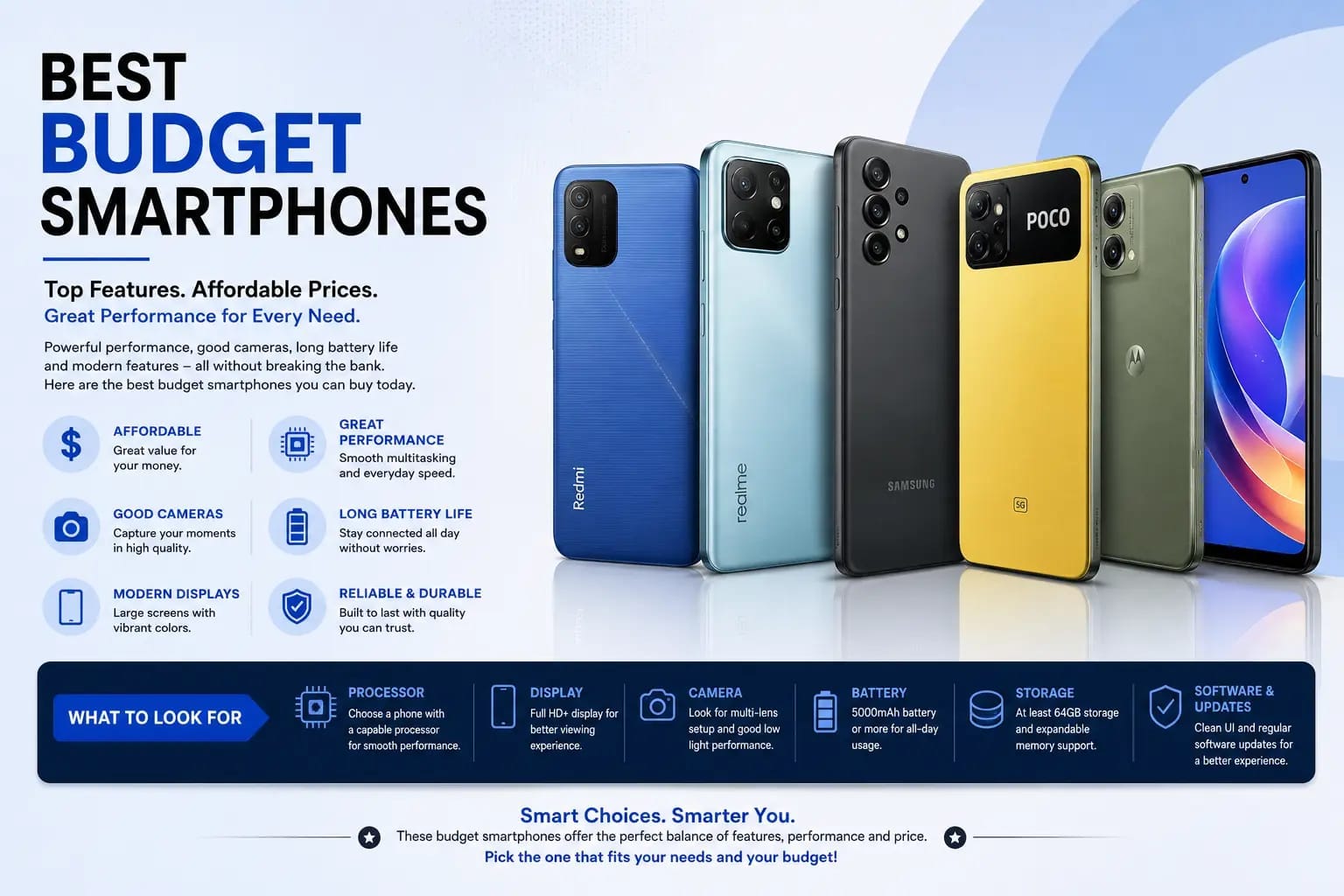
The best budget smartphones give you the features that matter most without the high price of a flagship phone. Today’s affordable options can offer smooth everyday performance, long battery life, capable cameras, bright displays, enough storage, and dependable software support. Whether you need a phone for social media, streaming, gaming, photography, or everyday tasks, the right budget smartphone depends on your priorities and budget. In this guide, we’ll compare the top options, their key features, pros and cons, and what to look for before buying, so you can find the best budget smartphone for your needs.
Introduction
Finding the best budget smartphones is no longer about settling for a slow phone with an average screen and a weak camera. The budget smartphone market has changed considerably, and many affordable models now offer smooth performance, dependable battery life, capable cameras, attractive displays, and features that were once associated with much more expensive phones.
The challenge is knowing which features actually matter. A smartphone may have a high megapixel camera, plenty of RAM, or a large battery, but those numbers do not always tell the whole story. Real-world performance depends on how well the hardware and software work together. That’s why choosing the best budget smartphone requires looking at the complete package rather than focusing on one impressive specification.
Whether you’re buying your first smartphone, replacing an older device, or simply want a reliable phone without spending too much, there are plenty of options worth considering. Some budget phones are designed for everyday tasks such as messaging, social media, browsing, and streaming, while others offer enough performance for gaming and photography.
In this guide, we’ll break down what makes the best budget smartphones worth your money, which specifications deserve attention, and how to choose a model that fits your everyday needs.
What Should You Expect From a Budget Smartphone?
A budget smartphone should provide a comfortable experience for the tasks you perform most often. You shouldn’t expect every affordable model to compete directly with premium flagship phones, but a good budget device should still feel responsive and dependable.
For most people, that means being able to open apps without excessive delays, switch between common applications, browse websites, watch videos, take photos, and communicate throughout the day without constantly worrying about performance or battery life.
Modern best budget smartphones can handle these everyday activities surprisingly well. The difference between a good option and a poor one often comes down to hardware balance, software optimization, update support, and build quality.
Rather than choosing a phone simply because it has the lowest price, consider how long you expect to keep it. Spending a little more on a well-balanced device can often provide a much better experience over the next few years.
Performance Matters More Than Big Numbers
Performance should be near the top of your list when comparing the best budget smartphones. A phone with a capable processor can make everyday activities feel much smoother, from opening apps to switching between multiple tasks.
You don’t necessarily need a flagship-level processor. For everyday users, a modern mid-range or entry-level chipset can be perfectly adequate. What matters is whether the processor can comfortably handle the apps and activities you use regularly.
RAM is another specification you’ll often see highlighted in smartphone advertisements. Having enough RAM helps with multitasking, but more RAM doesn’t automatically make one phone better than another. The processor, storage technology, and software all contribute to the overall experience.
If you regularly play demanding games, edit photos or videos, or use several resource-heavy apps, performance becomes even more important. In that case, it can be worth moving toward the upper end of your budget rather than choosing the cheapest available model.
Display Quality Can Change the Everyday Experience
The display is one of the parts of a smartphone you’ll use constantly, so it deserves more attention than it sometimes receives.
Many of today’s best budget smartphones offer larger screens with good resolution and smooth refresh rates. A higher refresh rate can make scrolling through websites and social media feel noticeably smoother, while a bright display makes it easier to use the phone outdoors.
Screen technology also matters. Some affordable phones use LCD panels, while others offer OLED or AMOLED displays. OLED-based screens can provide deeper blacks and stronger contrast, which can make videos, photos, and games look more impressive.
However, you shouldn’t choose a phone based on display technology alone. Brightness, color accuracy, viewing angles, resolution, and refresh rate all contribute to the overall experience.
Think about how you’ll use your phone. If you watch a lot of YouTube or Netflix, a good display may be one of the most valuable upgrades you can get. If you mainly use messaging and calls, you may prefer to put more of your budget toward battery life or performance.
Camera Quality Is About More Than Megapixels
Camera specifications can make choosing among the best budget smartphones confusing. Manufacturers often advertise high megapixel counts, but a larger number doesn’t automatically mean better photos.
Image quality depends on several factors, including the camera sensor, lens, image processing, stabilization, and software. A well-optimized camera with a lower megapixel count can produce better-looking pictures than a higher-resolution camera with weaker processing.
Think about the types of photos you take most often. If you mainly photograph friends, family, food, or outdoor scenes during the day, many affordable smartphones can produce good results.
Low-light photography is more demanding. If night photos are important to you, look for a phone with strong image processing and, where available, optical image stabilization.
The same principle applies to the front camera. If you frequently take selfies or make video calls, camera quality should be part of your buying decision.
Battery Life Should Match Your Routine
For many buyers, battery life is one of the biggest priorities when choosing the best budget smartphone.
A large battery can provide enough power to get through a busy day of messaging, browsing, streaming, and social media. But battery capacity isn’t the only factor that matters. Processor efficiency and software optimization can have a significant effect on real-world endurance.
Charging speed is also worth considering. Fast charging can be especially useful if you often forget to charge your phone overnight or need to quickly add some battery before leaving home.
If you’re a heavy user who spends hours gaming, streaming video, using GPS, or taking photos, don’t assume that a large battery alone guarantees excellent battery life. Look at independent testing and real-world reviews when possible.
Storage: Don’t Underestimate How Quickly It Fills Up
Storage is another feature that can have a major impact on your experience.
Apps are becoming larger, and photos and videos can consume storage surprisingly quickly. A phone that seems to have plenty of free space on the first day can become much more limited after months of regular use.
When comparing best budget smartphones, consider how you use your phone. Someone who mainly uses messaging apps and social media may be comfortable with less storage. Someone who downloads games, stores videos, and takes lots of high-resolution photos will benefit from more.
If a phone offers expandable storage, that can be useful, although support for memory cards varies between models.
It’s usually better to choose enough storage from the beginning rather than constantly having to delete files later.
Software Support Can Make a Big Difference
Hardware gets most of the attention when people compare smartphones, but software support is just as important for long-term value.
The best budget smartphones should ideally receive regular security updates and meaningful software support for a reasonable period. This can help keep the phone secure and ensure that it remains compatible with newer applications.
Before buying, check the manufacturer’s update policy for the specific model. Don’t assume that every phone from the same brand receives identical support.
The software interface itself also matters. Some manufacturers offer a relatively clean Android experience, while others add additional features and customization options. Neither approach is automatically better; it largely comes down to personal preference.
What matters most is that the software feels stable, responsive, and easy to use.
Build Quality Is Still Important
Affordable doesn’t have to mean poorly built.
Many modern budget phones use durable materials and include features that make them more practical for everyday use. Some models may also offer water or dust resistance, although the level of protection varies.
If you’re buying a phone for a teenager, a frequent traveler, or someone who tends to drop their device, durability may be more important than having the highest-resolution camera.
A good protective case and screen protector can also help extend the life of an affordable phone.
How to Choose the Best Budget Smartphone for You
There isn’t one smartphone that will be the best budget smartphone for everyone. Your priorities should determine which features deserve the most attention.
If you spend most of your time on social media and streaming, prioritize the display, battery, and overall performance.
If photography is your main concern, pay closer attention to camera processing, stabilization, and low-light performance.
For gaming, the processor, graphics performance, display refresh rate, and thermal management become more important.
For students or everyday users, reliability, battery life, storage, and software support may offer better value than premium camera features.
The key is to avoid paying for specifications you won’t actually use.
Final Thoughts
The best budget smartphones today can deliver a surprisingly complete smartphone experience without requiring a premium price. However, choosing the right model means looking beyond advertising claims and comparing the features that affect everyday use. Performance, display quality, cameras, battery life, storage, software support, and build quality all deserve consideration. The right balance will depend on your priorities and how much you’re willing to spend.
Comparing the Best Budget Smartphones by What Matters Most
Choosing between the best budget smartphones becomes much easier when you stop looking for one phone that does everything and instead think about what you actually need from your device.
A student who mainly uses WhatsApp, YouTube, Instagram, and Google Maps has different priorities from someone who plays demanding games every day. Likewise, a person who takes lots of photos may care more about camera processing and storage than charging speed.
The table below gives you a quick way to compare the main types of budget smartphones before looking at individual models.
| Smartphone Type | Best For | Key Strength | What to Check |
|---|---|---|---|
| Entry-level smartphone | Basic everyday use | Affordable price | Processor, RAM and storage |
| Mid-range budget phone | Everyday performance | Good overall balance | Display, chipset and software support |
| Camera-focused budget phone | Photography | Better camera system | Sensor quality and stabilization |
| Gaming-focused budget phone | Mobile gaming | Stronger performance | Chipset, cooling and refresh rate |
| Battery-focused budget phone | Heavy daily use | Long battery life | Battery capacity and charging |
| Compact budget phone | Easy handling | Comfortable size | Screen, battery and durability |
Best Budget Smartphones for Everyday Use
For most people, the ideal budget phone doesn’t need to specialize in one particular area. It simply needs to perform everyday tasks reliably.
A good all-rounder should be able to handle messaging, social media, browsing, streaming, online classes, video calls, photography, and light gaming without becoming frustrating to use.
This is where a balanced smartphone can be a better choice than a device with one standout feature. For example, a phone with an enormous battery isn’t necessarily a better purchase if its processor is noticeably slow. Similarly, a phone with an impressive camera may not be the right choice if it has limited storage.
When comparing the best budget smartphones, look for a device that performs well across several categories rather than dominating just one.
What Makes a Good All-Rounder?
A balanced budget phone should ideally have:
- A capable modern processor
- Enough RAM for everyday multitasking
- Adequate internal storage
- A bright and responsive display
- Reliable battery life
- A camera system that performs well in normal lighting
- Reasonable charging speed
- Good software support
- Solid build quality
You don’t need the most expensive option to get these features. The goal is to find the combination that gives you the most useful experience for your money.
Best Budget Smartphones for Gaming
Gaming has become increasingly important in the budget smartphone market. Affordable phones can now handle many popular mobile games, although performance varies considerably between models.
If gaming is a priority, don’t choose a phone based only on its RAM or display refresh rate. The processor and graphics performance are much more important.
A higher refresh-rate display can make supported games and animations feel smoother, but the phone still needs enough processing power to maintain consistent performance.
Features Gamers Should Look For
When choosing among the best budget smartphones for gaming, pay attention to:
- Processor and GPU performance
- Thermal management
- Display refresh rate
- Battery capacity
- Charging speed
- Available storage
- Touch response
- Software optimization
Storage is particularly important for gamers because modern games can take up a significant amount of space. If you plan to install several large games, avoid choosing a phone with barely enough storage for your current apps.
Don’t Ignore Heat Management
Performance isn’t just about how fast a phone is during the first few minutes of gaming. Long gaming sessions can generate heat, which may cause performance to decrease.
A phone with good thermal management can maintain more consistent performance over longer sessions. This is one reason why reading real-world reviews can be more useful than comparing specifications alone.
Best Budget Smartphones for Photography
If taking photos is one of your main reasons for upgrading, camera quality should be a major part of your decision.
The number printed beside the camera doesn’t tell the complete story. A high-resolution sensor can be useful, but image processing, lens quality, stabilization, and software features all influence the final result.
What to Look for in a Budget Camera Phone
For photography, look for:
- A good primary camera sensor
- Reliable autofocus
- Strong image processing
- Useful portrait mode
- Good dynamic range
- Reasonable low-light performance
- Stabilization where available
- A capable front camera
A phone that takes excellent daylight photos may still struggle at night. If you frequently take indoor or evening pictures, check how the camera performs in those conditions rather than relying on sample specifications.
Best Budget Smartphones for Battery Life
Battery life can make or break the smartphone experience.
A phone with excellent performance isn’t particularly useful if you constantly have to search for a charger. Fortunately, many affordable smartphones focus heavily on battery endurance.
For heavy users, look for a combination of a large battery, efficient processor, optimized software, and fast charging.
Battery Capacity Isn’t Everything
A bigger battery generally provides more capacity, but two phones with similarly sized batteries can have very different real-world endurance.
Screen brightness, refresh rate, processor efficiency, mobile network usage, gaming, background applications, and software optimization can all affect battery consumption.
That’s why battery tests and real-world user experiences can be more helpful than simply comparing battery numbers.
Pros and Cons of Budget Smartphones
Before choosing from the best budget smartphones, it’s worth understanding the advantages and compromises that usually come with this price category.
Pros
- Lower purchase price
- Excellent value for everyday use
- Good battery life on many models
- Increasingly capable cameras
- Smooth displays available at affordable prices
- Plenty of options for different types of users
- Lower replacement cost compared with premium phones
Cons
- Cameras may struggle in challenging lighting
- Gaming performance can vary considerably
- Some models have shorter software support
- Premium materials and features may be limited
- Charging speeds differ between models
- Some affordable phones include unwanted pre-installed apps
- Certain models may compromise on water resistance or other extras
These limitations don’t mean a budget phone is a poor choice. They simply show why it’s important to understand what you’re buying.
Buying Guide: How to Choose the Best Budget Smartphone
Buying a smartphone becomes much simpler when you establish your priorities before looking at specific models.
1. Set Your Budget First
Start with the amount you’re comfortable spending. Having a clear budget prevents you from paying extra for features that aren’t important to you.
Remember to consider the complete cost. A charger, protective case, screen protector, or additional storage may add to the final expense.
2. Decide What Matters Most
Ask yourself what you use your phone for every day.
Do you watch videos constantly? Prioritize the display.
Do you take hundreds of photos? Look for better camera hardware and sufficient storage.
Do you play games? Focus on the chipset and thermal performance.
Do you spend long hours away from home? Battery life should move higher on your list.
This simple approach can help you identify the best budget smartphone for your particular needs.
3. Check Storage Before Buying
Storage is one of the easiest specifications to overlook.
If you take lots of photos, record videos, download music, or install large games, choose more storage rather than trying to save a small amount of money upfront.
You should also check how much storage is actually available to the user because the operating system and pre-installed applications occupy part of the advertised capacity.
4. Look at Software Updates
A smartphone can remain useful for years, but software support varies between manufacturers and models.
Check the official update policy before purchasing. Longer security support can make a phone a much better long-term investment.
This is especially important if you plan to keep your smartphone for several years rather than replacing it frequently.
5. Check Network Compatibility
Before buying, make sure the phone supports the cellular bands and network features used by your carrier.
This is particularly important when purchasing an imported smartphone or ordering from an unfamiliar retailer. A phone can appear to be a bargain but become a poor purchase if network compatibility is limited.
6. Don’t Buy Based on One Specification
One of the biggest mistakes shoppers make is choosing a phone because of one impressive number.
A huge camera resolution, large battery, high RAM capacity, or fast refresh rate doesn’t guarantee a better smartphone.
The best budget smartphones are usually the ones that offer a sensible balance between performance, display quality, cameras, battery life, software, storage, and build quality.
New or Older Smartphone?
Sometimes an older mid-range phone can be more appealing than a brand-new entry-level model. However, this depends heavily on software support, battery condition, availability, and pricing.
An older model may offer better cameras or a stronger processor, while a newer budget phone may provide longer software support and a newer battery.
If you’re considering an older smartphone, check how many software updates remain and whether replacement parts and accessories are still easy to find.
What About Refurbished Budget Phones?
A refurbished smartphone can offer good value, but it’s important to buy from a reputable seller with a clear warranty or return policy.
Check the device’s condition, battery health where available, warranty coverage, and whether the phone is unlocked and compatible with your network.
A low price shouldn’t be the only reason to choose a refurbished phone. Reliability and after-sales support matter just as much.
Common Mistakes to Avoid
Even after finding several attractive options, it’s easy to make the wrong choice.
Choosing the Cheapest Phone
The cheapest phone isn’t always the best value. If it becomes slow, runs out of storage, or stops receiving important updates quickly, you may end up replacing it sooner.
Focusing Only on Camera Megapixels
More megapixels don’t automatically mean better photos. Look at the entire camera system and real-world results.
Ignoring Software Support
A phone with excellent hardware can become less attractive if its software support is limited.
Buying Too Little Storage
Running out of storage can become frustrating surprisingly quickly. Think about how you use your phone now and how that might change over the next few years.
Forgetting the Charger
Some smartphones may not include a charger in the box. Check what’s included before calculating the total cost of your purchase.
Final Thoughts
The best budget smartphones aren’t necessarily the cheapest models or the ones with the biggest numbers on their specification sheets. The better choice is usually the phone that gives you the right combination of features for the way you actually use it. For everyday users, a balanced device with dependable performance, a good display, strong battery life, enough storage, and reliable software support can provide excellent value. Gamers should prioritize the processor and cooling, while photography enthusiasts should pay closer attention to camera quality and image processing.
How to Choose the Best Budget Smartphone
By now, you should have a clearer idea of what matters when shopping for an affordable phone. But when you have several good options in front of you, the final decision can still be difficult.
The best budget smartphones are not identical. One may offer a better camera, another may have stronger performance, while a third could deliver excellent battery life. Instead of searching for a phone that wins in every category, focus on finding the model that performs well in the areas that matter most to you.
A little research before buying can make a big difference. Compare the specifications, check software support, read real-world reviews, and consider how long you want to keep the phone.
Which Features Are Worth Paying More For?
Not every upgrade deserves your money. When your budget is limited, you should spend extra on features that will make a noticeable difference in everyday use.
Better Processor
A stronger processor can improve app loading, multitasking, gaming, and the overall responsiveness of your phone. If you’re planning to keep your device for several years, spending a little more on performance can be worthwhile.
You don’t need the most powerful processor available. A modern, efficient chipset that comfortably handles your daily workload is usually enough.
More Storage
Additional storage is one of the upgrades that can genuinely improve long-term convenience.
If you regularly download games, save videos, take lots of photos, or use your phone for school or work, more storage can prevent headaches later.
For many buyers, paying slightly more for additional storage is more useful than paying for a camera feature they rarely use.
Better Display
A high-quality display can make the phone feel more premium every time you use it.
If you spend hours watching videos, browsing social media, reading, or gaming, a brighter screen with a smooth refresh rate can be a worthwhile upgrade.
However, don’t automatically choose the phone with the highest refresh rate. Brightness, color quality, viewing angles, and overall display tuning are also important.
Longer Software Support
Software support is one of the most valuable features for people who keep their phones for several years.
A phone that receives regular security updates and software improvements can remain useful for much longer than a model with similar hardware but limited support.
When comparing the best budget smartphones, consider the manufacturer’s update commitment rather than looking only at the phone’s launch specifications.
How to Compare Two Budget Smartphones
If you’re stuck between two models, create a simple comparison based on your priorities.
For example, you might compare:
| Feature | Phone A | Phone B | More Important If… |
|---|---|---|---|
| Performance | Good | Better | You game or multitask |
| Display | 120Hz | 90Hz | You watch videos or scroll often |
| Camera | Better | Good | You take lots of photos |
| Battery | Large | Large | You are a heavy user |
| Charging | Fast | Faster | You frequently recharge |
| Storage | 128GB | 256GB | You store lots of files |
| Software support | Longer | Shorter | You keep phones for years |
| Price | Lower | Higher | Your budget is limited |
This type of comparison makes the decision more practical. Instead of asking which phone is universally better, you’re asking which phone is better for you.
Best Budget Smartphones for Students
Students often need a phone that can handle several different tasks without becoming expensive.
Online classes, video calls, messaging, document viewing, social media, music, photography, and occasional gaming can all be part of a typical day.
For this type of user, battery life, storage, display quality, and reliable performance should usually be high on the list.
What Students Should Prioritize
A student-friendly budget smartphone should ideally offer:
- Strong battery endurance
- Enough storage for apps and documents
- A good display for reading and videos
- Reliable performance for multitasking
- A decent camera for everyday photos
- Good connectivity
- Long software support
You don’t necessarily need a gaming-focused device unless gaming is an important part of your routine.
Best Budget Smartphones for Families
When buying a phone for a family member, reliability can be more important than having the newest specifications.
A phone should be easy to use, provide dependable battery life, have sufficient storage, and receive software updates.
Durability can also be important. A sturdy design and a protective case may be more valuable than an advanced camera system if the phone will be used heavily every day.
Best Budget Smartphones for Heavy Users
Heavy smartphone users need a little more from their device.
If your phone is constantly handling streaming, navigation, social media, photography, gaming, and multitasking, performance and battery life become particularly important.
A slightly higher-priced model may make more sense in this situation because stronger hardware can provide a smoother experience and greater longevity.
Features Heavy Users Should Consider
Look for:
- Efficient processor
- Large battery
- Fast charging
- Good thermal management
- Plenty of storage
- Bright display
- Strong cellular connectivity
- Reliable software support
A balanced phone is generally better for heavy users than a device designed around one particular feature.
Best Budget Smartphones for Long-Term Use
If you don’t want to replace your phone every year or two, long-term value should be one of your biggest priorities.
The cheapest phone available today may not be the cheapest option over several years. A slightly better model with stronger hardware and longer software support can potentially remain useful for much longer.
What Makes a Phone Future-Ready?
Look for a combination of:
- Modern processor
- Sufficient RAM
- Plenty of storage
- Strong battery capacity
- Current software
- Long update support
- Durable construction
Future-proofing doesn’t mean buying the most expensive phone. It means avoiding hardware that is already close to its limits when you purchase it.
How to Get Better Value From Your Purchase
Finding the best budget smartphone isn’t only about choosing the right model. It’s also about buying at the right time and from the right seller.
Prices can change depending on promotions, new model launches, seasonal sales, and regional availability.
Before purchasing, compare prices from reputable retailers and check exactly what is included in the box.
Check the Warranty
A warranty can provide valuable protection if something goes wrong with the device.
Make sure you understand the warranty period, what’s covered, and how repairs or replacements are handled. This is particularly important when buying from smaller retailers or marketplace sellers.
Check the Return Policy
A clear return policy can give you additional peace of mind.
If you discover a serious issue after purchase, knowing your options can make the buying experience much easier.
Should You Buy Online or In a Store?
Both options have advantages.
Buying online can make it easier to compare prices, specifications, reviews, and different configurations. Physical stores, however, allow you to hold the phone, test the display, check its size, and get a feel for the software.
If you’re unsure about the phone’s size or design, seeing it in person can be especially helpful.
Regardless of where you buy, make sure the seller is trustworthy and the device is genuine.
Don’t Forget Accessories
The cost of a smartphone doesn’t always end with the phone itself.
You may also need a case, screen protector, charger, cable, memory card, or other accessories depending on the model.
These aren’t necessarily expensive, but including them in your budget gives you a more realistic idea of the total purchase cost.
A Simple Final Buying Checklist
Before purchasing one of the best budget smartphones, run through this checklist:
- Does the processor meet your everyday needs?
- Is there enough RAM for the way you multitask?
- Is the storage capacity sufficient?
- Is the display comfortable for your daily use?
- Does the camera meet your expectations?
- Can the battery last through your normal day?
- Is charging fast enough for your routine?
- How long will the phone receive software updates?
- Does it support your network?
- Is the build quality suitable for your lifestyle?
- Does the price fit your budget?
- Is the seller reputable?
- What warranty and return options are available?
If the answer is yes to most of these questions, you’re likely looking at a solid option.
More Information About Reviews, Please Visit Our Website: iPhone 13 Pro Max Review: A Premium Apple Flagship in 2026
REDMAGIC 10S Pro Review: Is This Gaming Phone Worth It?
REDMAGIC 11 Pro Review: Is This Gaming Phone Worth Buying?
Motorola Edge 2025 Review: Is This Midrange Phone Worth Buying in 2026?
Samsung Galaxy A55 5G Review: Is It Still Worth Buying in 2026
TCL 60 XE NXTAPER 5G Review: Is It Worth Buying in 2026?
Samsung Galaxy S22 Review: Is It Still Worth Buying in 2026?
iPhone 14 Review: Is It Still Worth Buying in 2026?
iPhone 17 Review: Is Apple’s iPhone 17 Worth Buying in 2026
Frequently Ask Question (FAQ) About Budget Smartphones
Are Budget Smartphones Worth Buying?
Yes. Modern budget smartphones can offer excellent value for everyday use. You can find models with good displays, capable processors, strong batteries, and useful cameras without paying flagship prices.
The important thing is to choose a phone that matches your needs rather than assuming the cheapest model is automatically the best deal.
How Long Can a Budget Smartphone Last?
The lifespan depends on the hardware, software support, battery health, and how heavily you use the phone.
A well-chosen budget phone can remain useful for several years, particularly when it receives regular security updates and has enough performance and storage for newer applications.
Are Budget Phones Good for Gaming?
Some are. Casual games can run comfortably on many affordable devices, while demanding games require a stronger processor and better thermal management.
If gaming is a major priority, consider a performance-focused model rather than choosing solely based on price.
Do Budget Smartphones Have Good Cameras?
Many do, especially in good lighting. However, camera performance varies widely between models.
Don’t judge a camera only by megapixel count. Look at image processing, stabilization, sensor quality, and real-world examples.
How Much Storage Is Enough?
The answer depends on how you use your phone.
Light users may be comfortable with lower storage, while gamers, photographers, and people who download lots of media should consider a higher-capacity model.
Should You Buy a Budget Phone or an Older Flagship?
It depends on the specific models.
An older flagship may offer premium cameras, performance, or materials, while a newer budget phone may provide longer software support and a newer battery.
Compare the actual condition, update support, price, and features before deciding.
Conclusion
Choosing the best budget smartphones is all about finding the right balance between price, performance, battery life, camera quality, display, storage, and software support. The cheapest option isn’t always the best value, so focus on the features that matter most for your daily use. With the right comparison and a clear budget, you can find a reliable smartphone that delivers great everyday performance without spending too much.