
Short Direct Answer
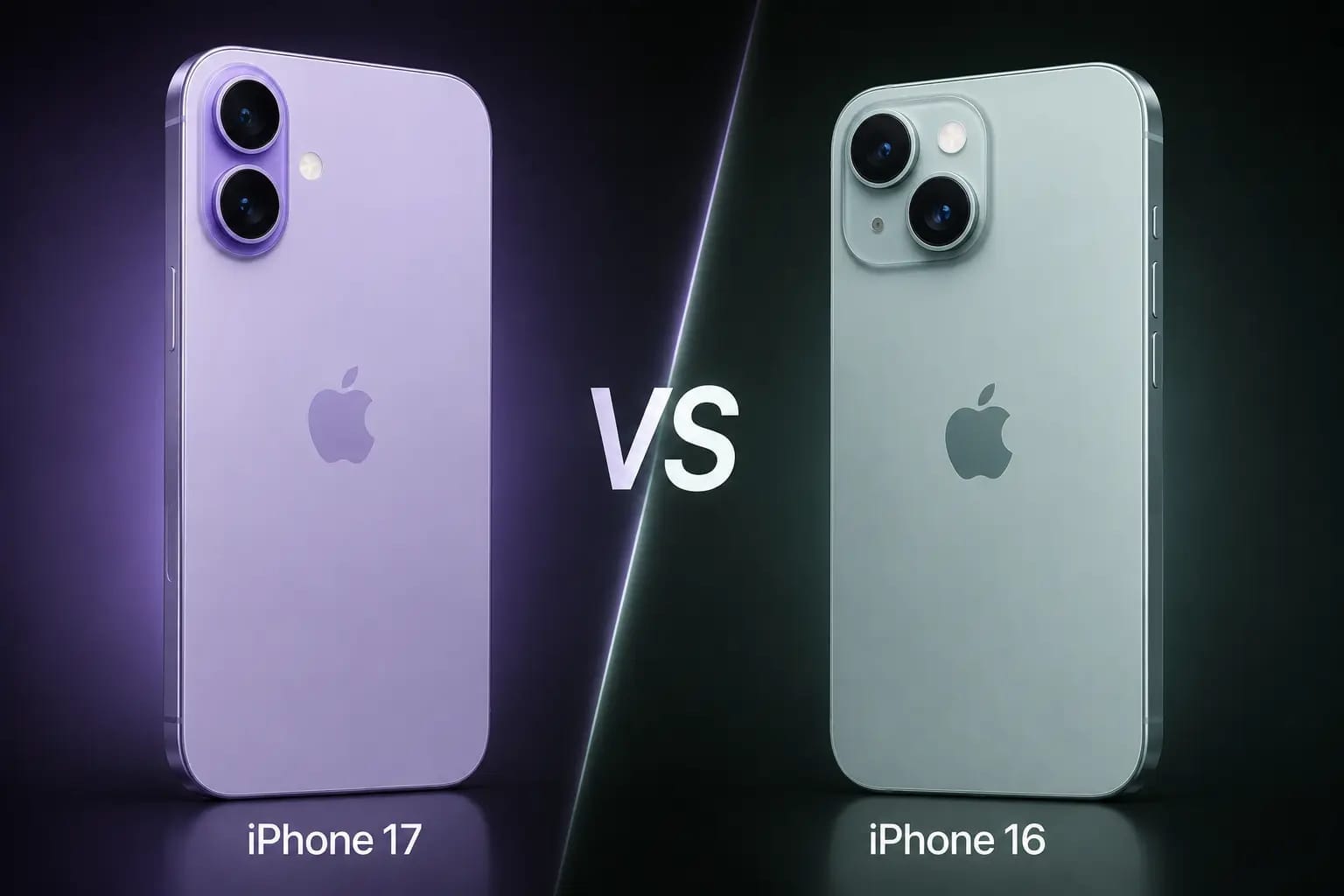
The iPhone 17 vs iPhone 16 comparison highlights the key differences between two generations of Apple’s standard iPhone lineup, including display, performance, cameras, battery life, design, and connectivity. This detailed comparison explores the specifications and features of both models to show exactly what has changed from the iPhone 16 to the iPhone 17.
iPhone 17 vs iPhone 16: Specifications, Features & Key Differences
1 iPhone 17 vs iPhone 16 – Design, Display, Performance and Specifications
The iPhone 17 vs iPhone 16 comparison is one of the most important questions for anyone looking for a new iPhone. At first glance, both smartphones follow Apple’s familiar premium design language, but the newer iPhone 17 introduces several meaningful upgrades. These improvements are especially noticeable in the display, processor, battery life, front camera and overall everyday experience.
The iPhone 16 remains a capable smartphone with the A18 chip, a 48MP Fusion main camera, Dynamic Island, Apple Intelligence support and a modern aluminum-and-glass design. However, the iPhone 17 moves the standard iPhone lineup closer to the experience traditionally associated with Apple’s higher-end models.
So, is the iPhone 17 really better than the iPhone 16, and should you upgrade? Let’s look at the major differences in detail.
iPhone 17 vs iPhone 16 Specifications at a Glance
Before getting into individual features, here is a quick comparison of the main specifications.
| Feature | iPhone 17 | iPhone 16 |
|---|---|---|
| Display | 6.3-inch OLED | 6.1-inch OLED |
| Refresh Rate | Up to 120Hz ProMotion | 60Hz |
| Chip | A19 | A18 |
| Main Camera | 48MP Fusion | 48MP Fusion |
| Ultra Wide Camera | 48MP Fusion Ultra Wide | 12MP Ultra Wide |
| Front Camera | 18MP Center Stage | 12MP TrueDepth |
| Storage | 256GB, 512GB | 128GB, 256GB, 512GB |
| Video Playback | Up to 30 hours | Up to 22 hours |
| Outdoor Brightness | Up to 3000 nits | Up to 2000 nits |
| Front Protection | Ceramic Shield 2 | Ceramic Shield |
| Charging | Up to 50% in 20 minutes with 40W+ adapter | Up to 50% in around 30 minutes with 20W+ adapter |
| Wireless Connectivity | Wi-Fi 7, Bluetooth 6 | Wi-Fi 7, Bluetooth 5.3 |
| Weight | 177g | 170g |
The specifications show that this is not simply a processor refresh. Apple has made upgrades across several areas, particularly the display, cameras and battery.
Design and Build Quality
Both models use an aluminum frame and a color-infused glass back, so the overall construction remains familiar. The iPhone 16 measures 147.6mm in height, 71.6mm in width and 7.8mm in thickness, with a weight of 170 grams.
The iPhone 17 is slightly taller and heavier. It measures 149.6mm tall, 71.5mm wide and 7.95mm thick, weighing 177 grams.
That means the difference in physical size is relatively small. The iPhone 17 is only slightly heavier, while its wider display provides a little more screen real estate. Both smartphones have an IP68 rating for water and dust resistance.
One of the most noticeable design-related changes is the front protection. The iPhone 17 introduces Ceramic Shield 2, along with an anti-reflective coating designed to improve outdoor viewing and scratch resistance. Apple says the new Ceramic Shield 2 provides substantially better scratch resistance than the previous generation.
Display: One of the Biggest iPhone 17 Upgrades
The display is arguably the biggest reason to choose the iPhone 17 over the iPhone 16.
The iPhone 16 features a 6.1-inch Super Retina XDR OLED display with a resolution of 2556 × 1179 pixels at 460 pixels per inch. It supports HDR, True Tone, P3 wide color and Dynamic Island.
The iPhone 17 increases the screen size to 6.3 inches and raises the resolution to 2622 × 1206 pixels at the same 460 ppi density. But screen size is not the most important upgrade.
The major difference is ProMotion technology with an adaptive refresh rate of up to 120Hz. The iPhone 16 standard model does not offer ProMotion.
This difference can be immediately noticeable when scrolling through websites, moving between menus, browsing social media or playing games. Animations appear smoother and motion feels more responsive on the iPhone 17.
The iPhone 17 also gets an Always-On display, allowing useful information such as the time, widgets and Live Activities to remain visible without fully waking the screen.
Brightness is another area where the iPhone 17 has an advantage. The iPhone 17 can reach up to 3000 nits of peak outdoor brightness, compared with up to 2000 nits on the iPhone 16.
For people who regularly use their phone outdoors, especially in bright sunlight, this can make the newer display easier to see.
Why 120Hz Matters in the iPhone 17 vs iPhone 16 Comparison
The move from a 60Hz display to up to 120Hz ProMotion is more important than a small increase in resolution.
On the iPhone 16, scrolling is smooth enough for everyday use, but the iPhone 17 provides a noticeably more fluid experience. The adaptive refresh rate can also adjust according to what is happening on the screen, helping balance smoothness and power efficiency.
For users who spend a lot of time browsing, watching content, editing photos or playing games, the iPhone 17 display is a major upgrade.
Performance: A19 vs A18 Chip
The iPhone 16 introduced the A18 chip, featuring a 6-core CPU with two performance cores and four efficiency cores, a 5-core GPU and a 16-core Neural Engine.
The iPhone 17 moves to the A19 chip. It continues with a 6-core CPU but adds a 5-core GPU with Neural Accelerators, a 16-core Neural Engine and hardware-accelerated ray tracing.
This makes the iPhone 17 better positioned for demanding apps, gaming, artificial intelligence features and long-term software support.
For ordinary tasks such as messaging, browsing, streaming and social media, however, the difference may not always feel dramatic. The A18 is already a powerful processor.
The larger advantage of the A19 is its combination of improved performance and efficiency. Apple’s newer chip is designed around a newer-generation manufacturing process and works with iOS 26 to provide better overall efficiency.
Apple Intelligence on Both iPhones
Another important point in the iPhone 17 vs iPhone 16 debate is Apple Intelligence.
Both smartphones support Apple Intelligence, so iPhone 16 owners are not automatically left behind when it comes to Apple’s AI-focused features.
This means upgrading solely for Apple Intelligence does not make much sense if you already own an iPhone 16. The iPhone 17’s advantage comes more from its newer hardware and the additional performance headroom provided by the A19 chip.
Storage Options
Storage is another practical difference.
The iPhone 16 is offered with 128GB, 256GB and 512GB storage options, while the iPhone 17 starts at 256GB and is also available with 512GB.
The 256GB starting capacity on the iPhone 17 is significant for people who store lots of photos, videos, games and applications. It also gives users more room for high-resolution media without immediately worrying about storage limits.
For someone who mainly uses cloud storage and doesn’t keep many large files on the device, the iPhone 16’s 128GB option can still be sufficient.
Battery Life: iPhone 17 Takes a Clear Lead
Battery life is another major difference in this comparison.
Apple rates the iPhone 16 for up to 22 hours of video playback, while the iPhone 17 is rated for up to 30 hours.
That is an increase of up to eight hours in Apple’s video-playback measurement.
Real-world battery life depends on network conditions, brightness, apps and usage patterns, but the specification clearly gives the iPhone 17 an advantage.
The newer phone also supports faster wired charging, reaching up to 50 percent in around 20 minutes when paired with a sufficiently powerful adapter. The iPhone 16 can reach 50 percent in around 30 minutes under Apple’s stated charging conditions.
For heavy users, this can make the iPhone 17 more convenient throughout the day.
Connectivity Improvements
The iPhone 17 also brings newer wireless connectivity features, including Wi-Fi 7 and Bluetooth 6. The iPhone 16 supports Wi-Fi 7 as well, while its Bluetooth specification is an earlier generation.
The iPhone 17 also introduces Apple’s N1 wireless networking chip, designed to support its newer connectivity capabilities.
For most everyday users, these improvements may not be immediately noticeable. However, they contribute to the iPhone 17’s more modern hardware platform and could become more valuable as compatible networks and accessories become more common.
1 Verdict
The first half of the iPhone 17 vs iPhone 16 comparison clearly favors the iPhone 17 in several important areas.
Its biggest advantages are the 6.3-inch display, 120Hz ProMotion, Always-On display, higher outdoor brightness, A19 chip, larger base storage, improved battery life and newer Ceramic Shield 2.
The iPhone 16, however, remains a strong option. Its A18 processor is powerful, its OLED display is excellent, Apple Intelligence is supported, and its 48MP main camera delivers a capable photography experience.
The bigger question is whether the camera system and other upgrades on the iPhone 17 justify choosing the newer model. That’s where the comparison becomes even more interesting.
iPhone 17 vs iPhone 16: Specifications, Features & Key Differences
2 iPhone 17 vs iPhone 16 – Camera, Battery, Features and Which One You Should Buy
The iPhone 17 vs iPhone 16 comparison becomes even more interesting when we move beyond the display and processor. While both phones offer strong performance and modern Apple features, the camera system is where the newer generation makes one of its most noticeable hardware changes.
The iPhone 16 already brought major camera improvements to the standard iPhone lineup, including a 48MP Fusion main camera, Camera Control and a 12MP Ultra Wide camera. The iPhone 17 builds on that foundation by upgrading the Ultra Wide camera and introducing a completely new 18MP Center Stage front camera.
For people who take selfies, record videos, make video calls or use their iPhone for content creation, these changes can be more important than the processor upgrade.
iPhone 17 vs iPhone 16 Camera Comparison
The iPhone 16 features a dual-camera system consisting of a 48MP Fusion main camera and a 12MP Ultra Wide camera.
The main camera has a 26mm equivalent focal length, an f/1.6 aperture, sensor-shift optical image stabilization and support for 24MP and 48MP photos. It also provides a 12MP 2x telephoto option using the main sensor.
The iPhone 17 keeps the 48MP Fusion main camera concept but upgrades the Ultra Wide camera to 48MP.
That is a significant specification change.
The iPhone 17’s 48MP Fusion Ultra Wide camera has a 13mm equivalent focal length, an f/2.2 aperture and a 120-degree field of view. It supports high-resolution 24MP and 48MP photography.
By comparison, the iPhone 16’s Ultra Wide camera has a 12MP sensor.
What Does the 48MP Ultra Wide Camera Mean?
An Ultra Wide camera is useful for landscapes, architecture, group photos and situations where you want to capture more of the scene.
Moving from 12MP to 48MP gives the iPhone 17 significantly more resolution potential. It can preserve more detail when shooting wide scenes and gives users greater flexibility when cropping images.
The difference will not necessarily be dramatic in every photograph, because image quality also depends on computational photography, lighting and image processing. Still, the hardware upgrade gives the iPhone 17 a clear advantage.
Front Camera: iPhone 17 Introduces Center Stage
The front camera is one of the clearest differences between the two models.
The iPhone 16 uses a 12MP TrueDepth camera with autofocus and support for 4K Dolby Vision video recording.
The iPhone 17 moves to an 18MP Center Stage camera with autofocus and Focus Pixels. It also introduces Center Stage for photos and video calls, along with features such as Dual Capture and ultra-stabilized video.
Center Stage is particularly interesting because it is designed to keep the subject better positioned during supported video calls and recordings.
For users who frequently make video calls or record themselves, the front camera upgrade could be one of the most useful changes in the entire iPhone 17 vs iPhone 16 comparison.
Video Recording
Both phones support high-quality 4K Dolby Vision video recording, but the iPhone 17 adds some new front-camera capabilities.
The iPhone 17’s Center Stage camera supports 4K Dolby Vision recording at multiple frame rates, while also offering ultra-stabilized video and Dual Capture.
The iPhone 16 remains highly capable for video. It supports 4K Dolby Vision recording, Cinematic mode, Action mode, macro video and spatial video recording.
Therefore, casual video users may not feel an enormous difference, but creators who regularly use the front camera have more reasons to consider the iPhone 17.
Camera Control on Both Models
One thing that should not be overlooked is that both the iPhone 16 and iPhone 17 include Camera Control.
This provides a dedicated physical control for interacting with the camera, including functions related to exposure, depth, zoom and other supported camera settings.
Therefore, Camera Control itself is not a reason to upgrade from an iPhone 16 to an iPhone 17.
The meaningful camera differences are primarily the upgraded Ultra Wide camera and the new 18MP Center Stage front camera.
Battery and Charging Comparison
Battery life is another area where the iPhone 17 clearly pulls ahead.
The iPhone 17 is rated for up to 30 hours of video playback, compared with up to 22 hours for the iPhone 16.
That gives the newer model a theoretical advantage of eight hours in Apple’s video playback measurement.
The difference is particularly useful for users who spend a lot of time watching videos, browsing, taking photos or using mobile applications throughout the day.
Charging has also improved. The iPhone 17 can reach up to 50 percent charge in 20 minutes with a 40W adapter or higher under Apple’s specified conditions.
The iPhone 16 reaches up to 50 percent in around 30 minutes using a 20W adapter or higher with USB-C charging.
The iPhone 17 therefore has an advantage not only in battery endurance but also in charging speed.
USB-C and MagSafe
Both smartphones use USB-C, so there is no major connector difference between the two.
Both also support MagSafe and wireless charging.
The iPhone 17 supports MagSafe wireless charging up to 25W and Qi2 wireless charging up to 25W under Apple’s specified conditions.
The iPhone 16 also supports MagSafe, so owners of existing compatible accessories don’t need to completely change their charging setup when moving between the generations.
Software Experience
Both phones benefit from Apple’s current software ecosystem and support Apple Intelligence.
The iPhone 17 ships with Apple’s newer software generation and has hardware specifically designed around the latest features. The A19 chip, improved Neural Engine capabilities and GPU Neural Accelerators give it more headroom for demanding on-device tasks.
The iPhone 16, meanwhile, remains well positioned because its A18 chip was designed with Apple Intelligence in mind.
This is important when deciding whether to upgrade. An iPhone 16 owner does not suddenly have an outdated phone simply because the iPhone 17 exists.
iPhone 17 vs iPhone 16: Which Has Better Display?
The answer is straightforward: the iPhone 17.
The 6.3-inch OLED panel is slightly larger, but the biggest improvement is ProMotion with an adaptive refresh rate up to 120Hz.
The iPhone 17 also has an Always-On display and can reach up to 3000 nits of outdoor brightness. The iPhone 16 offers a 6.1-inch OLED display with up to 2000 nits outdoor brightness but does not include ProMotion.
For display enthusiasts, this is one of the strongest reasons to choose the newer phone.
iPhone 17 vs iPhone 16: Which Has Better Performance?
The iPhone 17 wins here as well.
Its A19 chip is newer and includes a 5-core GPU with Neural Accelerators and hardware-accelerated ray tracing. The iPhone 16 uses the A18 chip with a 5-core GPU and 16-core Neural Engine.
For normal tasks, both are fast. But the A19 gives the iPhone 17 greater performance headroom for demanding applications, gaming and future software features.
iPhone 17 vs iPhone 16: Which Has the Better Camera?
The iPhone 17 takes the lead because of its 48MP Fusion Ultra Wide camera and 18MP Center Stage front camera.
The iPhone 16 still has an excellent 48MP main camera, and its 12MP Ultra Wide camera is capable for everyday photography.
If your photography mainly consists of standard photos and occasional videos, the iPhone 16 remains more than adequate. If you care about Ultra Wide photography, selfies, video calls or front-camera recording, the iPhone 17 is the more attractive choice.
iPhone 17 vs iPhone 16: Which Has Better Battery Life?
The iPhone 17 is the clear winner.
Apple rates the iPhone 17 for up to 30 hours of video playback, while the iPhone 16 is rated for up to 22 hours.
This is one of the largest specification differences between the two models and could matter significantly to heavy users.
Is iPhone 17 Worth Upgrading From iPhone 16?
For an existing iPhone 16 owner, the answer depends on how important the new features are.
If your iPhone 16 is working well and you are satisfied with its display, battery and cameras, there is no urgent reason to upgrade.
However, the iPhone 17 becomes much more tempting if you want:
- A 120Hz ProMotion display
- A larger 6.3-inch screen
- An Always-On display
- Better outdoor brightness
- Longer battery life
- Faster charging
- A newer A19 chip
- A 48MP Ultra Wide camera
- An 18MP Center Stage front camera
- 256GB as the starting storage capacity
- Newer wireless connectivity features
These are practical improvements rather than cosmetic changes.
Should You Buy iPhone 16 or iPhone 17?
For new buyers, the decision depends largely on budget and priorities.
The iPhone 16 makes sense for users who want a powerful modern iPhone without necessarily needing every newest feature. It has a strong 48MP main camera, A18 chip, Apple Intelligence, Dynamic Island, Camera Control, OLED display and a familiar premium design.
The iPhone 17 is the better choice for users who want the latest standard iPhone experience. Its 120Hz ProMotion display, A19 processor, improved battery life, upgraded Ultra Wide camera, 18MP Center Stage camera and larger base storage make it a more complete package.
More Information About Reviews, Please Visit Our Website: Samsung Galaxy A56 Specifications: Features & Details
Huawei Pura 80 Ultra: Specs, Camera, Features & Review
Samsung Best Camera Phone: Top Galaxy Camera Phones
Huawei P30 Pro: Features, Performance, Camera and More
Best Budget Smartphones: Top Affordable Picks
iPhone 13 Pro Max Review: A Premium Apple Flagship in 2026
REDMAGIC 10S Pro Review: Is This Gaming Phone Worth It?
REDMAGIC 11 Pro Review: Is This Gaming Phone Worth Buying?
Motorola Edge 2025 Review: Is This Midrange Phone Worth Buying in 2026?
Final Verdict: iPhone 17 vs iPhone 16
The final iPhone 17 vs iPhone 16 verdict depends on what you expect from your smartphone.
The iPhone 16 is still a highly capable device and remains a sensible choice for users who prioritize value and don’t need the latest display or camera improvements. Its A18 processor is powerful, its main camera is excellent and it supports many of Apple’s newest software features.
But the iPhone 17 is the more advanced phone overall.
Its 120Hz ProMotion display is arguably the most noticeable everyday upgrade, while the A19 chip, longer battery life, faster charging, 48MP Ultra Wide camera and 18MP Center Stage front camera add further advantages.
In simple terms, the iPhone 16 is the better option for someone who wants strong performance without paying for every new feature, while the iPhone 17 is the better option for someone who wants the newest display, camera improvements, longer battery life and more future-ready hardware.
For someone upgrading from an older iPhone, the iPhone 17 offers a particularly complete package. For an existing iPhone 16 user, however, the upgrade is most worthwhile if the 120Hz display, battery improvements and camera upgrades are features you will actually use.
Overall, when looking strictly at specifications, features and key differences, the iPhone 17 wins the iPhone 17 vs iPhone 16 comparison, but the iPhone 16 remains a strong and capable alternative.
Conclusion
Overall, the iPhone 17 vs iPhone 16 comparison clearly favors the iPhone 17, thanks to its 120Hz ProMotion display, A19 chip, longer battery life, upgraded cameras, faster charging and larger starting storage. The iPhone 16 is still a powerful and reliable choice, but if you want the latest features and a more future-ready iPhone, the iPhone 17 is the better pick.