
Short Direct Answer:
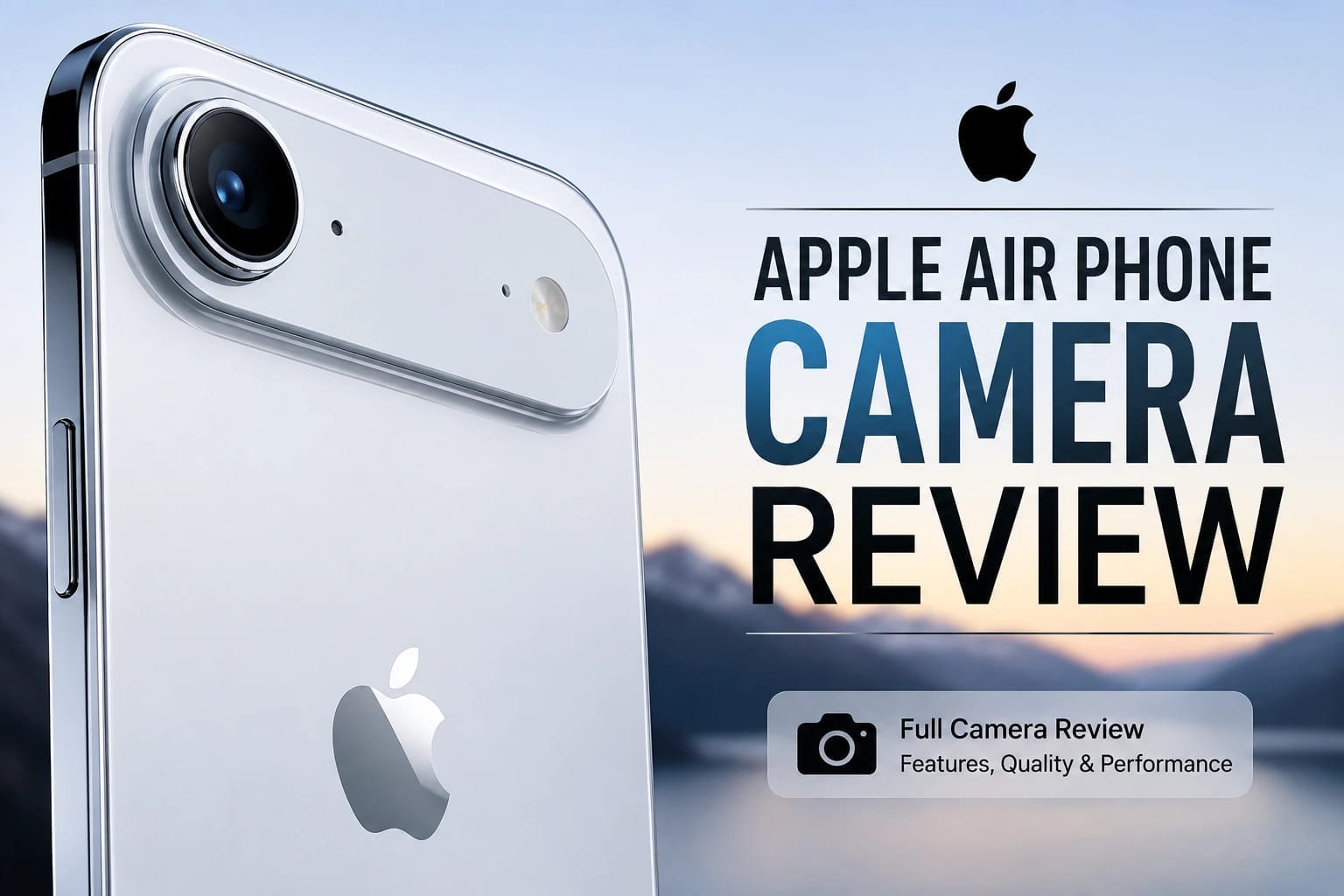
Apple Air Phone Camera Review: The iPhone Air has a strong 48MP main camera, excellent 18MP Center Stage selfie camera, fast A19 Pro performance, and a superb 120Hz display. Its biggest compromises are the single rear camera, limited zoom flexibility, and only average battery endurance.
Introduction
If you searched for an apple air phone camera review, you are probably wondering whether Apple’s ultra-thin iPhone Air can deliver flagship-level photography without the larger camera system found on Pro models.
The answer is nuanced. The iPhone Air combines a 48MP Fusion Main camera with an 18MP Center Stage front camera, while its A19 Pro chip provides plenty of performance. The catch is that there is only one rear camera, so you lose the dedicated ultrawide and telephoto lenses available on more camera-focused iPhones.
This makes the Air an interesting choice for people who value a remarkably thin 5.6mm design, low weight, display quality, and everyday speed more than maximum camera versatility.
Apple Air Phone Specifications
| Specification | iPhone Air |
|---|---|
| Processor | Apple A19 Pro, 6-core CPU, 5-core GPU |
| RAM | 12GB reported by multiple reviewers; Apple does not officially list RAM in its technical specifications |
| Battery | Built-in lithium-ion battery; Apple rates it for up to 27 hours of video playback |
| Camera | 48MP Fusion Main rear camera; 18MP Center Stage front camera |
| Display | 6.5-inch Super Retina XDR OLED, ProMotion up to 120Hz |
Apple officially confirms the A19 Pro configuration, camera specifications, display and 27-hour video-playback rating. RAM and battery capacity are not officially published by Apple; independent sources report 12GB RAM and a roughly 3,149mAh battery.
Pros and Cons
Pros
- Extremely thin and light titanium design
- Excellent 6.5-inch OLED display with 120Hz ProMotion
- Powerful A19 Pro processor
- Very good 48MP main-camera image quality
- Excellent 18MP Center Stage selfie camera
- Strong 4K Dolby Vision video capabilities
- Useful 2x optical-quality crop from the main camera
- 256GB base storage
- eSIM-only design and modern wireless connectivity
Cons
- Only one rear camera
- No dedicated ultrawide or telephoto lens
- Battery endurance is weaker than larger flagship iPhones
- Intensive gaming can produce noticeable heat
- Premium $999 starting price
- USB-C data transfer is limited to USB 2 speeds
- Camera flexibility is substantially lower than Pro models
The central trade-off is simple: the Air prioritizes thinness and portability over camera hardware and sustained performance. That compromise is also what makes the phone different from a conventional flagship.
Real-World Testing
Independent hands-on reviews generally agree that the iPhone Air feels exceptionally fast in everyday use. Apps open quickly, multitasking is smooth, and the A19 Pro has more than enough power for browsing, social media, video editing, photography, and demanding apps.
Battery life: Battery performance is good rather than class-leading. Apple’s official rating is up to 27 hours of downloaded video playback and up to 22 hours of streamed video. In one standardized web-browsing test, the Air lasted about 12 hours, while TechRadar reported roughly four hours and 45 minutes of average active screen time in its testing. Results naturally vary with brightness, cellular use, gaming, camera use, and other factors.
Gaming: The A19 Pro provides flagship-class gaming performance. Independent testing found demanding games playable, although the Air’s five-core GPU is below the six-core version used in the iPhone 17 Pro models. Long gaming sessions can also expose the Air’s thermal limitations.
Heating: Heat is one of the more consistent criticisms. Because the Air concentrates much of its internal hardware around the camera plateau, intensive gaming and other sustained workloads can make that area noticeably warm. Tom’s Guide measured temperatures around 106–109°F during a short Asphalt Legends session, while WIRED reported a higher hotspot during an extended Assassin’s Creed Mirage test.
Everyday experience: For ordinary tasks, the limitations are much less noticeable. Calls, messaging, browsing, streaming, social apps, photography, and normal multitasking are handled comfortably. The Air’s biggest everyday advantage is physical: at 165 grams and only 5.64mm thick, it feels dramatically lighter and slimmer than many large flagship phones.
Apple Air Phone Camera Review: Camera Quality
The rear camera is where this iPhone becomes most interesting—and most controversial.
The iPhone Air uses a 48MP Fusion Main camera rather than the multi-camera setup found on Apple’s Pro models. Apple says the system provides the equivalent of four lenses through its sensor and computational photography capabilities, but that does not replace the physical flexibility of having separate ultrawide and telephoto cameras.
apple air phone camera review: Daylight Photos
In good lighting, the main camera is a strong performer. Independent reviews found photos to be sharp, natural-looking and generally well balanced, with Apple’s processing producing convincing colors and useful dynamic range.
The limitation becomes apparent when you want a genuinely wide composition or substantial optical zoom. The Air can crop the main sensor for a 2x optical-quality view, but it cannot provide the same flexibility as an iPhone with dedicated ultrawide and telephoto cameras.
apple air phone camera review: Night Photos
Night photography remains capable, particularly for ordinary scenes where the main sensor has enough light and Apple’s computational processing can do its work.
However, the lack of an ultrawide camera means you cannot switch to a dedicated wide lens when photographing a large building, landscape, or group in a confined space. That is a hardware limitation rather than something software can completely solve.
Portrait Quality
Portrait photography is one of the Air’s strengths. The main camera supports next-generation portraits with Focus and Depth Control, while the 18MP front camera also supports portrait photography and Portrait Lighting.
For people who mainly photograph friends, family, pets and everyday subjects, the results should be more than sufficient. The bigger issue is not portrait quality but lens variety.
Video Performance
Video is arguably one of the Air’s strongest camera areas. The rear and front cameras support 4K Dolby Vision recording, while the front camera adds stabilization, Center Stage, and Dual Capture features.
That makes the Air particularly appealing for casual creators, video calls and social-media video. Apple also includes Action mode and other computational video features, giving the single-camera system more versatility than its hardware might initially suggest.
Camera Strengths and Weaknesses
Camera strengths
- Detailed 48MP main-camera output
- Strong daylight image quality
- Good portrait processing
- Excellent front-facing camera
- 4K Dolby Vision video
- Useful 2x crop from the main sensor
- Center Stage makes group selfies and video calls more flexible
Camera weaknesses
- No dedicated ultrawide camera
- No dedicated telephoto camera
- Limited long-range photography
- No dedicated macro lens
- Less photographic flexibility than Pro iPhones
apple air phone camera review: The camera verdict is therefore straightforward: the iPhone Air takes good photos, but it is not Apple’s most versatile camera phone. If image quality at 1x and 2x matters most, the Air performs well. If you regularly use ultrawide, macro or telephoto photography, the single rear camera will eventually feel restrictive.
Price and Availability
Apple launched the iPhone Air at $999 in the United States for 256GB, with 512GB and 1TB versions also available. It comes in Space Black, Cloud White, Light Gold and Sky Blue.
For Pakistan, current retailer and price-tracking listings vary considerably depending on storage, PTA status, warranty and seller. Recent August 2026 listings put the 256GB model roughly in the Rs. 385,000–Rs. 480,000 range, while higher-capacity and PTA-approved versions can cost substantially more. Prices can change with exchange rates and local stock, so buyers should confirm the final price and PTA status before purchasing.
The official Apple launch lineup starts at 256GB, followed by 512GB and 1TB. There is no 128GB version in Apple’s official specifications.
Comparison With Competitors
iPhone Air vs iPhone 17
The regular iPhone 17 is the more practical choice for many buyers. Both phones have a 48MP Fusion Main camera and the same 18MP Center Stage front camera, but the iPhone 17 adds a 48MP Fusion Ultra Wide camera.
The Air counters with a thinner, lighter body and the A19 Pro chip. For someone who values portability above all else, the Air is more distinctive. For photography and overall value, the standard iPhone 17 is arguably the safer choice.
iPhone Air vs iPhone 17 Pro
The iPhone 17 Pro is considerably more camera-focused. It has three 48MP rear cameras and a six-core GPU, giving it substantially greater flexibility for zoom, ultrawide photography and demanding workloads.
apple air phone camera review: Choose the Air for its unique thin design and lighter weight. Choose the Pro if cameras, sustained gaming performance and maximum flagship capability matter more.
iPhone Air vs Galaxy S25 Edge
Samsung’s Galaxy S25 Edge is perhaps the most obvious Android comparison because it also targets buyers who want an exceptionally thin flagship.
The Galaxy offers a two-camera rear setup, while the iPhone Air has only one rear camera. Independent testing has also found differences in sustained performance and camera results between the two, so neither phone is simply better in every category.
apple air phone camera review: The Air makes more sense for buyers already invested in Apple’s ecosystem and who prioritize iOS, video quality and the extremely thin design. The Galaxy is worth considering if you want Android and more rear-camera flexibility.
Frequently Asked Questions
Is the iPhone Air camera good?
Yes. The 48MP Fusion Main camera produces detailed, natural-looking photos and supports strong video recording. Its main weakness is not image quality but versatility because there is no dedicated ultrawide or telephoto camera.
Does the iPhone Air have a telephoto camera?
No. The iPhone Air has a single 48MP rear camera. It can provide a 2x optical-quality crop, but it does not have a separate telephoto lens.
How good is the iPhone Air for video?
It is very good for video. The rear and front cameras can record 4K Dolby Vision video, and the front camera adds stabilization, Center Stage and Dual Capture features.
Does the iPhone Air get hot while gaming?
It can. Independent tests found noticeable heat around the camera plateau during sustained gaming and demanding workloads. Normal everyday use generally produces much less heat.
How long does the iPhone Air battery last?
Apple rates it for up to 27 hours of downloaded video playback and up to 22 hours of streamed video. Independent tests suggest that real-world endurance is respectable but below larger flagship iPhones, particularly during heavy use.
Is the iPhone Air worth buying?
It is worth considering if you want an exceptionally thin and light iPhone with a premium display, powerful performance and a capable main camera. If you need the best camera versatility, longest battery life or sustained gaming performance, an iPhone 17 Pro-class alternative is a better fit.
More Information About Reviews, Please Visit Our Website: Samsung Galaxy A56 Specifications: Features & Details
Huawei Pura 80 Ultra: Specs, Camera, Features & Review
Samsung Best Camera Phone: Top Galaxy Camera Phones
Huawei P30 Pro: Features, Performance, Camera and More
Best Budget Smartphones: Top Affordable Picks
iPhone 13 Pro Max Review: A Premium Apple Flagship in 2026
REDMAGIC 10S Pro Review: Is This Gaming Phone Worth It?
REDMAGIC 11 Pro Review: Is This Gaming Phone Worth Buying?
Motorola Edge 2025 Review: Is This Midrange Phone Worth Buying in 2026?
Conclusion
The iPhone Air is an excellent choice for buyers who want a thin, lightweight iPhone with a powerful processor, beautiful 120Hz display, and reliable everyday camera performance. Its 48MP main camera takes impressive photos and its video capabilities are strong.
However, the single rear camera is a significant limitation for serious photographers. If you need ultrawide shots, stronger zoom, longer battery life, or sustained gaming performance, the iPhone 17 Pro is the better choice.
Buy the iPhone Air for its design, portability, performance, and excellent main camera. Choose a Pro model if camera versatility is your top priority.