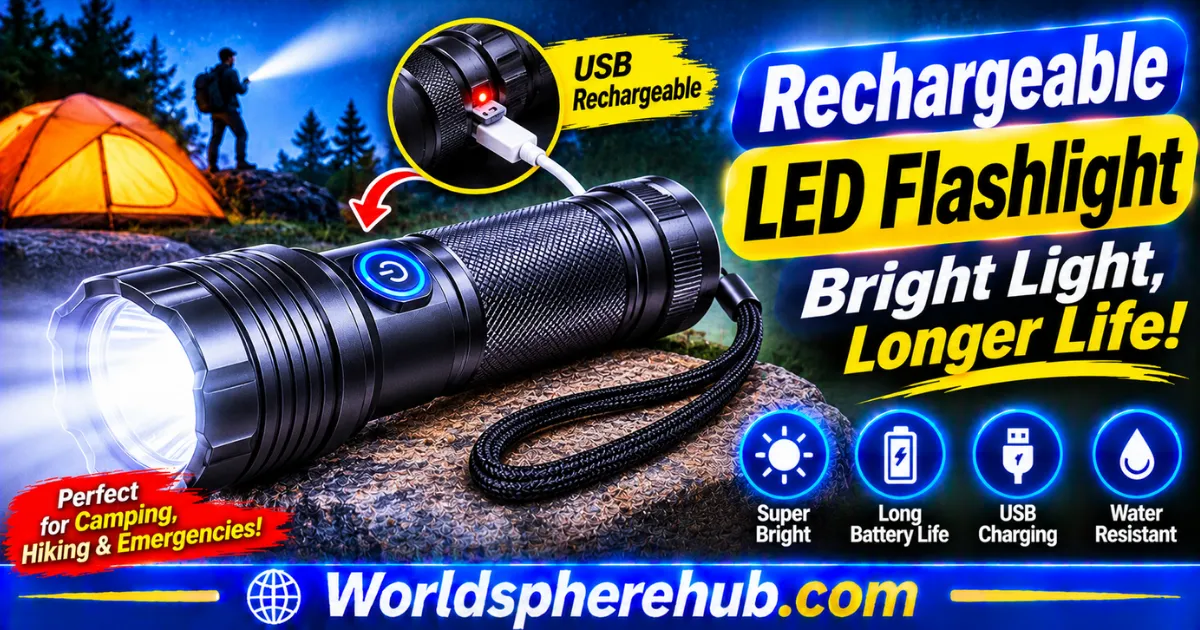
Rechargeable LED Flashlight: Bright and Tough
SHORT DIRECT ANSWER
A rechargeable LED flashlight uses a built-in or replaceable lithium battery you charge through USB-C or a magnetic cable, delivering bright light without disposable batteries. Compare lumens, runtime, beam distance, charging method, water resistance, and size, because high brightness often lasts only briefly before the light steps down.
Quick Picks by Use
| Use | Examples from recent roundups | What stands out |
|---|---|---|
| Everyday carry | Olight Baton 4, Fenix E18R V2.0, Sofirn SC13 | Small size, pocket clip, magnetic tail |
| Tactical or duty | Streamlight ProTac 2.0, Olight Warrior 3S, Fenix PD36R Pro | Dual switches, strong throw, durable build |
| High output outdoors | Fenix TK21R, Fenix PD36R Pro, Olight Seeker 4 Pro | Thousands of lumens and long beam distance |
| Budget-friendly | Anker Bolder LC40, Sofirn lights | Good brightness and USB-C charging |
| AA-compatible backup | Nitecore MT2A Pro | Rechargeable but can also use AA batteries |
Models and specifications change quickly, and several brands launched new versions in 2026, including Olight’s Baton 4 Pro and Baton Ultra in April. Treat these as examples rather than endorsements.
Brightness: Lumens, Candela, and Throw
Most flashlight boxes advertise lumens, which measure total light output. More lumens mean a brighter, wider glow, but they are not the whole story. Three numbers matter:
- Lumens: Total brightness, useful for lighting up a room or campsite
- Candela: Intensity at the center of the beam, which affects how far light reaches
- Beam distance: How far the light reaches before it fades, usually measured under the ANSI FL1 standard
A light with 1,300 lumens, such as the Olight Baton 4 with a listed 170-meter throw, can be perfect for everyday use. A 2,800-lumen light like the Fenix PD36R Pro, with a listed beam of about 380 to 415 meters depending on the source, is better for searching large areas. Extremely bright lights can be overkill indoors and drain batteries fast.
Many flashlights can only hold maximum brightness for a short time. They step down automatically to prevent overheating, so check sustained output and runtime, not just peak lumens.
Runtime and Battery Types
Runtime depends on battery capacity and brightness. A small 650mAh built-in battery, like the one listed for the Olight Baton 4, is great for pocket size but gives limited high-output time. Larger cells give much longer use. The Fenix PD36R Pro, for example, is listed with a 5,000mAh 21700 battery.
| Battery type | Pros | Cons |
|---|---|---|
| Built-in lithium-ion | Compact and convenient | Not user-replaceable in most designs |
| 18650 or 21700 cell | Long runtime and replaceable | Larger and heavier |
| AA compatible | Flexible in emergencies | Lower output on some AA cells |
One roundup lists a rechargeable light with up to 60 hours of runtime at 10 lumens and about 45 minutes at 3,000 lumens, which shows how quickly high output drains the battery. For emergencies, a low or medium mode often gives the best balance of brightness and endurance.
Charging: USB-C, Magnetic, and Proprietary Options
Charging convenience is a big selling point.
USB-C Charging
USB-C is the most common and most flexible. You can charge with the same cable and adapter used for your phone, laptop, or tablet. Many lights, including the Fenix PD36R Pro, Fenix TK21R, Streamlight ProTac 2.0, and Sofirn SC13, use USB-C. Charge times vary, with the TK21R listed at about 1.5 hours and the PD36R ACE at about 3 hours.
Magnetic Charging
Olight popularized proprietary magnetic charging cables that snap onto the tail of the light. The Olight Baton 4 and Warrior 3S use this approach. It is quick and easy, but you need the brand’s cable, so buy a spare for a bag or car.
Power Bank Function
Some larger lights can charge a phone in an emergency. This is helpful in power outages, but it uses up flashlight battery, so use it carefully.
Beam Shape and Optics
Flashlights fall into two broad beam styles:
- Flood beams spread light widely for close work, camping, and walking
- Throw beams focus light into a tight spot for distance, searching, and security
Some lights blend both with a hotspot and a wide spill. If you want one flashlight for home use and the occasional outdoor trip, a balanced beam is a safe choice. If you search large properties or walk trails at night, a longer-throw light such as the Fenix PD36R Pro or Fenix TK21R makes more sense.
Modes and Controls
Common modes include low, medium, high, turbo, strobe, and SOS. Useful features include:
- Lockout: Prevents accidental activation in a bag or pocket
- Memory: Remembers your last mode
- Dual switches: A tail switch for quick on and off and a side switch for modes, as on the Fenix PD36R Pro and PD36R ACE
- Proximity sensor: On some lights, reduces brightness if something is too close, as on the Olight Warrior 3S
- Battery indicator: Shows remaining charge
Simple controls matter more than endless modes. In an emergency, you want a light you can operate with one hand, in the dark, with gloves on.
Durability and Water Resistance
Look for these ratings:
| Rating | Meaning |
|---|---|
| IPX4 | Splash resistant |
| IPX7 | Survives brief immersion in water |
| IPX8 | Withstands deeper or longer immersion, depending on the manufacturer |
| IP68 | Dust tight and waterproof |
Listings cite IPX8 for the Olight Baton 4 and IP68 for the Fenix TK21R and Nitecore MT2A Pro. Impact resistance matters too, since flashlights get dropped. Aluminum bodies are common and sturdy, while cheaper plastic bodies may not handle drops as well.
Heat Management and Safety
Bright LEDs make heat, and many lights reduce output after a few minutes to protect the LED and battery. That is normal. A hot flashlight can still be a problem if you cover it or leave it in a closed bag while on.
Lithium batteries also deserve respect:
- Charge with a cable and adapter that suits the light
- Do not leave it charging unattended for long periods
- Avoid charging a swollen, damaged, or very hot battery
- Keep spare lithium cells in cases so terminals do not touch metal
- Follow airline rules, which generally require lithium batteries in carry-on bags
Check the manufacturer’s instructions for your light.
Size, Carry, and Mounting
Size affects how often you will actually carry a flashlight. A tiny keychain or pocket light such as the Sofirn SC13, listed at 2.54 inches and 1.41 ounces, is easy to take everywhere. A larger tactical light such as the Fenix PD36R Pro offers more power but is a belt or bag item.
Useful features include:
- Pocket clips for EDC use
- Magnetic tail caps for hands-free work under cars and sinks
- Lanyard holes for hiking
- Anti-roll designs for tables and benches
Practical Uses
| Situation | What helps |
|---|---|
| Home emergencies | Medium output with long runtime and an easy switch |
| Car or garage | Magnetic tail and a durable body |
| Camping and hiking | High lumens, flood beam, and water resistance |
| Work and repairs | Pocket clip, magnetic base, and compact size |
| Security and patrol | Long throw, strobe, and a robust build |
Buying Checklist
| Check | Why it matters |
|---|---|
| Lumens and beam distance under ANSI FL1 | Gives a fair way to compare lights |
| Runtime at medium and low output | Shows real endurance |
| Charging type and time | Affects convenience |
| Battery type and replaceability | Matters for long-term use |
| Water resistance rating | Helps in rain and outdoor use |
| Controls and modes | Easier use in the dark |
| Size and weight | Decides whether you actually carry it |
| Warranty and brand support | Important for batteries and electronics |
Strengths and Limitations
| Strengths | Limitations |
|---|---|
| No disposable batteries needed | Peak output often lasts only briefly |
| Bright, efficient LEDs | Battery degrades over time |
| USB-C or magnetic charging | Proprietary chargers can be inconvenient |
| Wide range of sizes and styles | High-lumen lights can be bulky |
| Useful for emergencies and daily use | Lithium batteries need careful handling |
Who Should Buy a Rechargeable LED Flashlight?
A rechargeable LED flashlight is a smart upgrade for almost every home. Everyday carry fans, campers, drivers, tradespeople, and anyone preparing for power outages will find a use for one. For most people, a compact light with around 500 to 1,300 lumens and USB-C charging is plenty, while specialized users may want a larger, brighter model.
If you want a backup that works without charging, consider a light that also accepts standard batteries, and keep spare batteries on hand. Prices and availability vary, so compare current listings and read the specifications carefully.
Frequently Asked Questions
1: How many lumens do I need in a rechargeable flashlight?
For most home and everyday uses, 300 to 1,300 lumens is plenty. For searching large areas or long-distance viewing, 2,000 lumens or more can help, but runtime drops quickly at high output.
2: What is the difference between lumens and beam distance?
Lumens measure total light output, while beam distance shows how far the light reaches. A flashlight can be bright with a wide beam but still have limited throw.
3: Is USB-C charging better than magnetic charging?
USB-C is more universal because you can use common cables. Magnetic charging is quick and convenient, but it usually requires the brand’s own cable.
4: Are rechargeable flashlights safe in an emergency?
Yes, if you keep them charged and know how to use them. Store a spare battery or backup light, and check the charge level regularly so the light is ready when needed.
5: What does IPX8 mean on a flashlight?
IPX8 means the flashlight is rated to withstand water immersion under conditions specified by the manufacturer. It is better protection than basic splash resistance.
Explore More Continue Reading Our Guide on: Portable DVD Player Review: Features & Travel
Bluetooth Keyboard Review: Features & Comfort
Wireless Charging Pad: Qi2 Speed, Cases, Tips
USB-C Charger Buying Guide: Wattage Made Easy
Wireless HDMI Transmitter: Ditch Cables Today
Aura Digital Picture Frame Review: Full Guide
Conclusion
A rechargeable LED flashlight delivers bright light, USB-C or magnetic charging, flexible sizes, and no disposable batteries for everyday use and emergencies. Key limitations include brief peak output, battery wear, proprietary chargers, bulky high-lumen models, and careful lithium battery handling.