
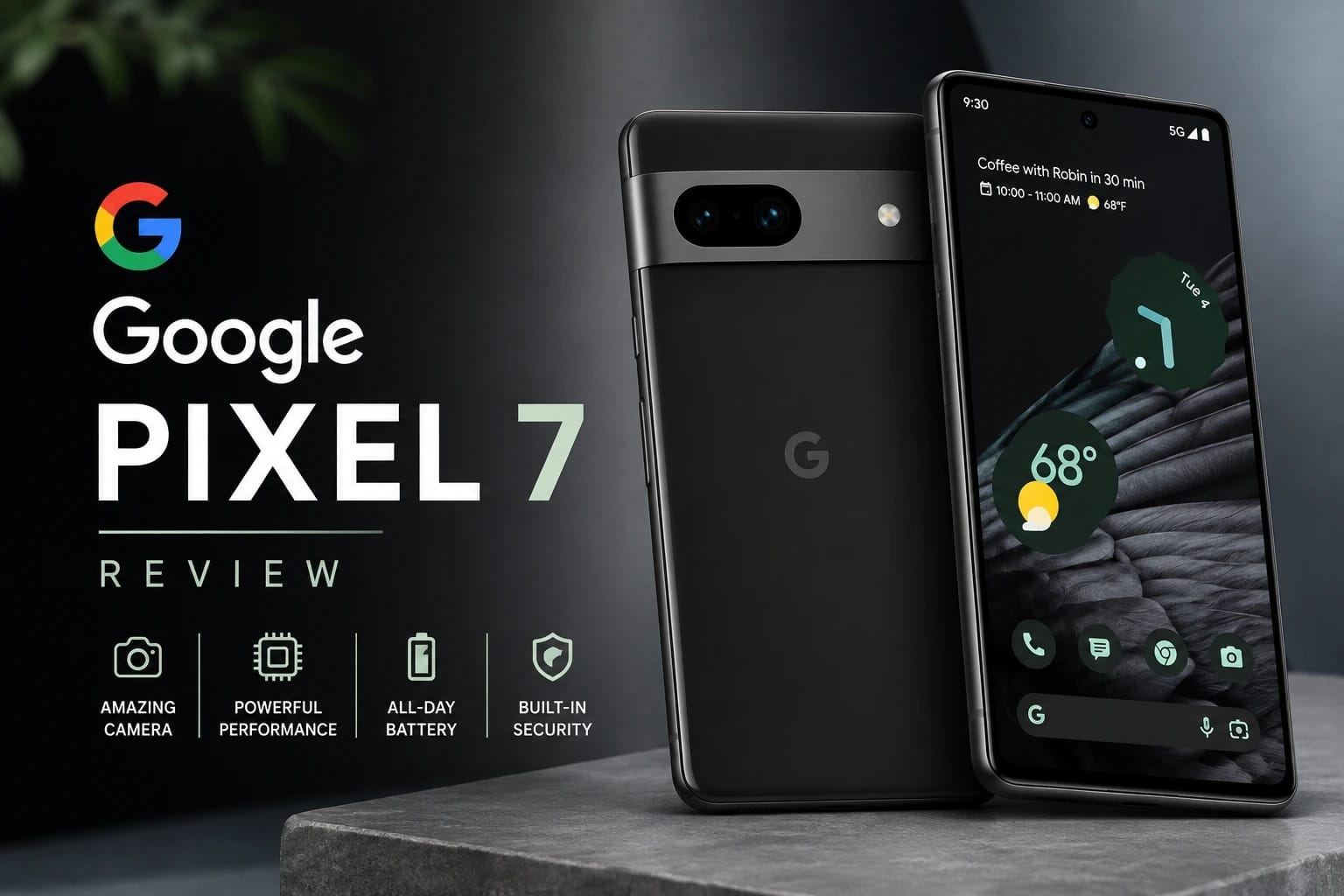
Quick Answer
The Google Pixel 7 is a smartphone with a 6.3-inch OLED display, Google Tensor G2 processor, 8GB RAM, 128GB or 256GB storage, a 50MP main camera, 12MP ultrawide camera, and 10.8MP front camera. It also features a 4,355mAh battery, wireless charging, 5G connectivity, Face Unlock, fingerprint security, and Google camera and software features such as Magic Eraser, Photo Unblur, and Clear Calling.
Google Pixel 7: Features, Specifications & Review
Introduction
The Google Pixel 7 is a smartphone built around Google’s Tensor G2 processor, a high-quality OLED display, a dual rear camera system, and Google’s Android software experience. It combines a compact design with photography, performance, security, and everyday smartphone features.
The phone has a 6.3-inch OLED display, 8GB of RAM, storage options of 128GB and 256GB, and a 4,355mAh battery. Its rear camera system includes a 50MP main camera and a 12MP ultrawide camera, while the front camera has a 10.8MP sensor.
Google Pixel 7 Overview
The Google Pixel 7 is designed as a premium smartphone with a focus on camera performance, Google’s software features, and smooth everyday performance.
Its main specifications include:
- 6.3-inch OLED display
- Google Tensor G2 processor
- 8GB RAM
- 128GB or 256GB storage
- 50MP main rear camera
- 12MP ultrawide rear camera
- 10.8MP front camera
- 4,355mAh battery
- 5G connectivity
- Wireless charging
- Fingerprint sensor
- Face Unlock
- USB-C connectivity
Google Pixel 7 Design and Build
The phone has a modern design with rounded corners and a horizontal camera bar across the rear.
The camera bar gives the Pixel 7 a distinctive appearance and separates the rear camera system from the main body.
The front is dominated by the display, with a small centered hole-punch cutout for the front camera.
Build
The Google Pixel 7 uses a glass back with an aluminum frame.
Its design combines a premium appearance with a practical smartphone form factor.
The phone is also IP68-rated for dust and water resistance, providing protection against dust and water under specified testing conditions.
Google Pixel 7 Display
The Google Pixel 7 features a 6.3-inch OLED display with a 20:9 aspect ratio.
The display provides strong contrast, deep blacks, and vibrant colors, making it suitable for everyday smartphone use.
Display Resolution
The screen has a resolution of 2400 × 1080 pixels, providing a sharp viewing experience for text, photos, videos, and applications.
Refresh Rate
The display supports a refresh rate of up to 90Hz.
This allows compatible content and system animations to appear smoother than on a standard 60Hz display.
Display Protection
The front display is protected by Corning Gorilla Glass Victus.
This provides additional resistance against everyday scratches and accidental damage, although a protective case and screen protection can still be useful.
Google Pixel 7 Processor
The Google Pixel 7 is powered by the Google Tensor G2 processor.
Tensor G2 was designed by Google to handle everyday smartphone performance as well as Google’s camera, speech, security, and machine-learning features.
Everyday Performance
The processor handles common tasks such as:
- Web browsing
- Social media
- Video streaming
- Photography
- Messaging
- Apps
- Gaming
- Navigation
The combination of Tensor G2 and 8GB RAM provides the phone with the hardware needed for normal multitasking and demanding smartphone functions.
Google Pixel 7 RAM and Storage
The phone comes with 8GB of RAM.
This allows the device to keep multiple applications and processes active while switching between everyday tasks.
Storage Options
Google Pixel 7 is available with:
- 128GB storage
- 256GB storage
The available capacity depends on the specific version.
The phone does not include a microSD card slot, so users need to choose the storage capacity they need when purchasing the device.
Google Pixel 7 Operating System
The Google Pixel 7 originally launched with Android 13.
As a Google Pixel device, it receives Google’s Android software updates and Pixel-specific features.
The software provides access to Google’s applications and services while also integrating features designed specifically for Pixel phones.
Android Experience
The interface is designed around a clean Android experience with Google’s own software features.
Users can access applications, notifications, settings, widgets, Google Assistant features, and other Android functions directly from the device.
Google Pixel 7 Performance
The combination of Tensor G2 and 8GB RAM gives the Google Pixel 7 enough performance for everyday applications and demanding tasks.
Apps can be opened and switched between smoothly, while the processor also handles image processing and Google’s machine-learning-based features.
Gaming
The Tensor G2 processor and integrated graphics can handle mobile games.
Performance can vary depending on the game, graphics settings, temperature, and other factors.
The 90Hz display can also provide smoother movement in supported games and applications.
Google Pixel 7 Security
Security is built into both the hardware and software of the phone.
The Google Pixel 7 includes an in-display fingerprint sensor that can be used to unlock the device and authenticate supported actions.
Fingerprint Sensor
The fingerprint sensor is located beneath the display.
It provides a biometric unlocking option without requiring a physical fingerprint button on the front or rear of the phone.
Face Unlock
The Google Pixel 7 also supports Face Unlock.
The front camera can recognize the user’s face for supported unlocking functions.
This gives users another convenient way to access the phone.
Google Pixel 7 Software Features
Google adds several software features to the Pixel 7 beyond standard Android functions.
These features are closely connected with the phone’s Tensor G2 processor and Google software.
Some of the notable features include:
- Magic Eraser
- Photo Unblur
- Real Tone
- Face Unblur
- Clear Calling
- Recorder features
- Assistant voice features
These functions are designed to make photography, calls, voice recording, and everyday smartphone use more convenient.
Google Pixel 7 Connectivity
The phone supports modern wireless connectivity features.
These include:
- 5G
- 4G LTE
- Wi-Fi
- Bluetooth
- NFC
- GPS
- USB-C
5G
The Google Pixel 7 supports 5G connectivity on compatible networks.
5G can provide faster mobile data speeds and lower latency where supported by the network and carrier.
Wi-Fi and Bluetooth
Wi-Fi provides wireless internet connectivity, while Bluetooth can be used with compatible headphones, speakers, cars, and other accessories.
NFC
NFC is included for compatible wireless communication and supported contactless functions.
The Google Pixel 7 combines a 6.3-inch OLED display, Tensor G2 processor, 8GB RAM, up to 256GB storage, and Google’s Android software experience.
Google Pixel 7: Camera, Battery & Hardware Features
Google Pixel 7 Camera
The phone has a dual rear-camera setup consisting of a 50MP main camera and a 12MP ultrawide camera. It also has a 10.8MP front camera for selfies and video calls. Google’s computational photography features work alongside the camera hardware to improve photos in different situations.
The camera system is one of the main hardware features of this device, with tools designed for everyday photography, portraits, landscapes, and low-light shots.
Main Camera
The 50MP main camera is the primary sensor on the rear.
It is designed to capture detailed photographs and uses Google’s image-processing technology to improve the final image. Optical image stabilization also helps reduce the effect of small hand movements when taking photos or recording video.
Main Camera Features
The main sensor supports features such as:
- Optical image stabilization
- Laser autofocus
- Dual-pixel autofocus
- HDR photography
- Night Sight
- Portrait Mode
- Photo Unblur
- Magic Eraser
- Real Tone
These features combine camera hardware with Google’s software processing.
Ultra-Wide Camera
The second rear sensor is a 12MP ultrawide camera.
It provides a wider field of view than the primary sensor, making it useful when you need to capture more of a scene in a single frame.
Ultra-Wide Photography
The wider lens is useful for:
- Landscapes
- Buildings
- Group photographs
- Travel scenes
- Large indoor spaces
Users can switch between the standard and wider perspective depending on the subject.
Front Camera
The front-facing camera has a 10.8MP sensor.
It is positioned in a small hole-punch cutout at the top of the display and can be used for selfies, video calls, and supported face-unlocking functions.
Selfie Features
Google’s image processing works with the front sensor to produce processed selfies.
The camera can also record video and works with the device’s Face Unlock feature.
Camera Software Features
Google’s computational photography is an important part of the camera experience.
Instead of relying only on camera hardware, the phone processes images using software and machine-learning technology.
Magic Eraser
Magic Eraser lets users remove unwanted objects or distractions from compatible photographs.
It is designed for quick editing and can help clean up parts of an image without using a separate editing application.
Photo Unblur
Photo Unblur is designed to improve certain blurry photographs.
It can help recover the appearance of detail in images affected by movement or lack of sharpness.
Night Sight
Night Sight is designed for low-light photography.
The feature uses computational processing to produce brighter and more detailed images in darker environments.
Real Tone
Real Tone is designed to improve the representation of different skin tones in photographs.
It works as part of Google’s camera-processing system to produce more natural-looking results across different subjects and lighting conditions.
Portrait Mode
Portrait Mode uses software processing to separate a subject from its background and create a background-blur effect.
It is particularly useful for portraits and subject-focused photographs.
Video Recording
The rear cameras can record high-resolution video, while stabilization helps produce smoother footage.
Available recording options include:
- 4K video
- 1080p video
- Slow motion
- Time-lapse
- Stabilized video
The exact options can vary depending on the selected camera and recording mode.
Battery
The handset has a 4,355mAh battery. Google’s current specifications also list this battery capacity for the model.
Battery performance depends on how the phone is used.
Activities such as gaming, GPS navigation, video recording, high display brightness, and mobile data can consume more power than lighter tasks.
Everyday Battery Use
The battery supplies power for everyday activities such as:
- Calling
- Messaging
- Web browsing
- Social media
- Video streaming
- Photography
- Navigation
- Applications
Actual battery duration will vary according to settings, network conditions, and usage.
Charging
The device supports wired charging through its USB-C port and also supports wireless charging.
Wired Charging
USB-C provides the physical connection for charging the battery.
It can also be used for compatible data connections and accessories.
Wireless Charging
Wireless charging allows the phone to charge on a compatible charging pad without connecting a cable directly to the handset.
The charging performance depends on the compatible charging equipment and conditions.
Connectivity
The device supports a range of modern wireless and wired connectivity options.
These include:
- 5G
- 4G LTE
- Wi-Fi
- Bluetooth
- NFC
- GPS
- USB-C
5G Connectivity
5G support allows the phone to connect to compatible fifth-generation mobile networks.
Actual network speeds depend on the carrier, network availability, signal strength, and location.
Wi-Fi and Bluetooth
Wi-Fi provides wireless internet connectivity for activities such as browsing, streaming, downloading applications, and online communication.
Bluetooth allows the phone to connect with compatible wireless accessories, including headphones, speakers, cars, and other devices.
NFC
NFC provides short-range wireless communication for supported functions.
It can be used with compatible services and accessories that support NFC technology.
GPS
GPS provides location information for supported applications and services.
It can be used for navigation, maps, location-based applications, and outdoor activities.
USB-C Port
The phone uses a USB-C port for wired charging and data connections.
USB-C can also be used with compatible accessories.
There is no traditional 3.5mm headphone jack, so wired audio requires compatible USB-C accessories or an appropriate adapter.
Audio
The device has stereo speakers for music, videos, games, calls, and other audio content.
Wireless headphones and other Bluetooth audio accessories can also be connected.
Hardware Protection
The phone has an IP68 dust and water resistance rating.
This provides protection against dust and water under specified testing conditions. Water resistance can decrease over time through normal wear or physical damage.
Sensors
The handset contains sensors that support different hardware and software functions.
These include components used for:
- Fingerprint authentication
- Motion detection
- Proximity detection
- Ambient-light detection
- Orientation
- Location
These sensors help Android and installed applications respond to movement, lighting, position, and other conditions.
Hardware Overview
The combination of the 50MP main sensor, 12MP ultrawide camera, 10.8MP front camera, Tensor G2 processor, 4,355mAh battery, and OLED display gives the device its main hardware capabilities.
Its camera system relies heavily on computational photography, while the processor handles everyday applications and machine-learning features.
The connectivity hardware also provides 5G, Wi-Fi, Bluetooth, NFC, GPS, and USB-C support.
The Google Pixel 7 features a 50MP main camera, 12MP ultrawide camera, and 10.8MP selfie camera. Its photography tools include Night Sight, Magic Eraser, Photo Unblur, Real Tone, and Portrait Mode. The phone also has a 4,355mAh battery, wired and wireless charging, 5G, Wi-Fi, Bluetooth, NFC, GPS, USB-C, stereo speakers, and IP68 protection.
Google Pixel 7: Software Features, Security & Final Review
Software Experience
The phone runs Google’s Android software with a clean interface and features designed around everyday use. Its software works closely with the Tensor G2 processor, especially for photography, voice processing, calls, and other machine-learning functions.
Users can customize the home screen, manage notifications, use widgets, install applications, and access Google’s built-in services.
Smart Software Features
Google’s software adds several useful functions beyond the standard Android experience. These include:
- Magic Eraser
- Photo Unblur
- Face Unblur
- Real Tone
- Clear Calling
- Recorder features
- Voice-related Assistant functions
These tools are integrated into the phone rather than requiring separate hardware.
Magic Eraser
Magic Eraser is a photo-editing tool that can remove unwanted objects or distractions from compatible images.
It is designed for quick edits and can be accessed through Google Photos.
Photo Unblur
Photo Unblur uses computational processing to improve certain blurry images.
It can be useful for photos where movement or focus has reduced clarity.
Face Unblur
Face Unblur is designed to improve the appearance of faces affected by motion blur in compatible photographs.
This feature works through Google’s image-processing technology.
Real Tone
Real Tone is designed to improve the representation of different skin tones in photographs.
It works as part of Google’s computational photography system and is intended to produce more accurate-looking results across different subjects and lighting conditions.
Clear Calling
Clear Calling is designed to improve voice-call clarity by reducing distracting background sounds.
It uses software processing to help make conversations easier to hear when there is surrounding noise.
Recorder Features
The built-in Recorder application can capture audio directly from the phone.
Google’s speech-processing technology can also provide transcription features where supported, allowing recorded conversations or speech to be converted into text.
Security Features
The device combines Android security features with biometric authentication.
Fingerprint Sensor
An in-display fingerprint sensor provides a convenient way to unlock the phone.
It can also be used for supported authentication tasks.
Face Unlock
Face Unlock provides another way to access the device.
The front-facing camera recognizes the registered face and can unlock the phone when the feature is available and configured.
Performance Experience
The Tensor G2 chip and 8GB of RAM provide enough hardware for everyday smartphone tasks.
The device can handle:
- Web browsing
- Messaging
- Social media
- Video streaming
- Photography
- Video recording
- Navigation
- Applications
- Mobile gaming
- Multitasking
The processor also contributes to Google’s photography and machine-learning features.
Camera Experience
Photography is one of the most important parts of this Pixel device.
The 50MP main camera and 12MP ultrawide camera provide different shooting options, while Google’s computational photography adds features such as Night Sight, Magic Eraser, Photo Unblur, and Real Tone.
The 10.8MP front camera handles selfies, video calls, and Face Unlock.
Battery Experience
The phone has a 4,355mAh battery.
Battery life depends on factors such as screen brightness, network conditions, applications, gaming, camera use, GPS, and mobile data.
It supports wired charging through USB-C and wireless charging.
Connectivity
The device supports several common connectivity technologies, including:
- 5G
- 4G LTE
- Wi-Fi
- Bluetooth
- NFC
- GPS
- USB-C
These features support mobile internet, wireless accessories, navigation, data connections, and other everyday smartphone functions.
Pros and Cons
Pros
- 6.3-inch OLED display
- Up to 90Hz refresh rate
- Tensor G2 processor
- 8GB RAM
- 128GB and 256GB storage
- 50MP main camera
- 12MP ultrawide camera
- 10.8MP front camera
- Strong computational photography
- Magic Eraser
- Photo Unblur
- Night Sight
- Real Tone
- Clear Calling
- Face Unlock
- In-display fingerprint sensor
- 5G connectivity
- Wireless charging
- IP68 dust and water resistance
- USB-C port
Cons
- No microSD card slot
- No 3.5mm headphone jack
- Battery performance depends on usage
- Some features vary by region and software
- Cellular capabilities depend on carrier support
Specifications Table
| Feature | Specification |
|---|---|
| Display | 6.3-inch OLED |
| Resolution | 1080 × 2400 |
| Refresh Rate | Up to 90Hz |
| Processor | Google Tensor G2 |
| RAM | 8GB |
| Storage | 128GB / 256GB |
| Main Camera | 50MP |
| Ultrawide Camera | 12MP |
| Front Camera | 10.8MP |
| Battery | 4,355mAh |
| Charging | Wired and wireless |
| Network | 5G |
| Port | USB-C |
| Fingerprint Sensor | In-display |
| Face Unlock | Yes |
| Water Resistance | IP68 |
| Launch OS | Android 13 |
These core specifications match Google’s published Pixel 7 information.
FAQs
1 What processor does the Google Pixel 7 use?
It uses Google’s Tensor G2 processor.
2 How much RAM does the Pixel 7 have?
The phone comes with 8GB of RAM.
3 What storage options are available?
The device is available with 128GB and 256GB of internal storage.
4 How many rear cameras does it have?
There are two rear cameras: a 50MP main camera and a 12MP ultrawide camera.
5 Does it support wireless charging?
Yes, wireless charging is supported.
6 Does it have 5G?
Yes, 5G connectivity is supported on compatible networks.
7 Does it have a fingerprint sensor?
Yes. It has an in-display fingerprint sensor.
8 Does it support Face Unlock?
Yes, Face Unlock is available.
9 Does it have a headphone jack?
No, there is no traditional 3.5mm headphone jack.
10 Does it support microSD?
No, there is no microSD card slot.
More Information About Reviews, Please Visit Our Website: Huawei Pura 80 Ultra: Specs, Camera, Features & Review
Samsung Best Camera Phone: Top Galaxy Camera Phones
Huawei P30 Pro: Features, Performance, Camera and More
Best Budget Smartphones: Top Affordable Picks
iPhone 13 Pro Max Review: A Premium Apple Flagship in 2026
REDMAGIC 10S Pro Review: Is This Gaming Phone Worth It?
REDMAGIC 11 Pro Review: Is This Gaming Phone Worth Buying?
Motorola Edge 2025 Review: Is This Midrange Phone Worth Buying in 2026?
Samsung Galaxy A55 5G Review: Is It Still Worth Buying in 2026
Final Verdict
The Google Pixel 7 brings together a 6.3-inch OLED display, Tensor G2 processor, 8GB RAM, capable dual-camera hardware, Google’s photography tools, wireless charging, 5G, and biometric security.
Its strongest areas are its camera processing and software features. Tools such as Magic Eraser, Photo Unblur, Real Tone, and Clear Calling add useful functions to the standard smartphone experience. Google’s official feature information confirms these software capabilities.
Conclusion
The Google Pixel 7 is a well-rounded smartphone with strong camera features, Tensor G2 performance, a smooth OLED display, useful software tools, wireless charging, 5G, and solid security options. Its combination of hardware and Google’s software features makes it a capable everyday phone.