
Quick Answer
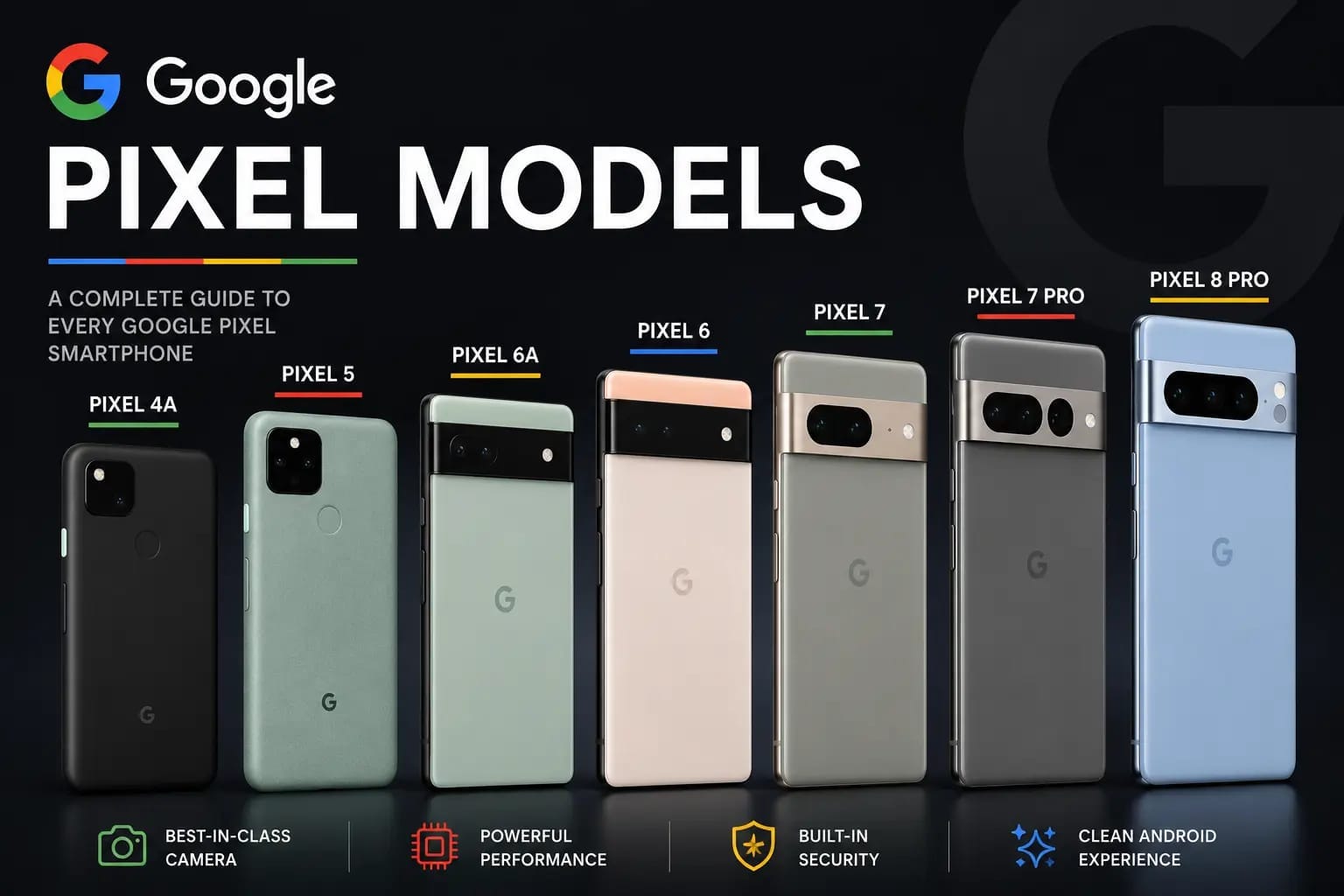
Google Pixel models offer a range of smartphones with different designs, camera systems, performance levels, security features, and Android experiences. The models shown here include the Pixel 4a, Pixel 5, Pixel 6a, Pixel 6, Pixel 7, Pixel 7 Pro, and Pixel 8 Pro. Across these devices, key features include Google’s camera technology, Pixel processors, built-in security, and a clean Android experience, while the exact display, camera, battery, processor, and other specifications vary by model.
Google Pixel Models: Design, Display, Performance & Core Features
Introduction
Google’s Pixel lineup has changed significantly from one generation to the next, but the main idea has remained the same: a clean Android experience, strong camera technology, and hardware designed around Google’s software. The models shown in the lineup include the Pixel 4a, Pixel 5, Pixel 6a, Pixel 6, Pixel 7, Pixel 7 Pro, and Pixel 8 Pro.
Each phone has its own combination of display size, processor, cameras, battery, storage, and design. The older models are more compact and simple, while the newer devices introduce more powerful Tensor processors, larger displays, improved cameras, and more advanced software features.
Google Pixel Models Overview
The Pixel 4a, Pixel 5, Pixel 6a, Pixel 6, Pixel 7, Pixel 7 Pro, and Pixel 8 Pro represent different stages of Google’s smartphone development.
The Pixel 4a focuses on a compact body and simple everyday smartphone experience. The Pixel 5 adds a larger display, 5G connectivity, and a more refined design.
The Pixel 6a brings Google’s Tensor processor to a smaller and more affordable Pixel design, while the Pixel 6 introduces a new visual design with Google’s distinctive camera bar.
The Pixel 7 continues that design and improves the processor and camera experience. The Pixel 7 Pro adds a larger display and a more advanced camera setup. The Pixel 8 Pro moves the series further with a brighter display, newer processor, and additional camera and software capabilities.
Pixel 4a
The Pixel 4a is the most compact model in the lineup shown.
It features a 5.81-inch OLED display with a Full HD+ resolution. The phone has a simple rear design with a square camera module and a rear-mounted fingerprint sensor.
It is powered by the Qualcomm Snapdragon 730G processor and comes with 6GB of RAM and 128GB of internal storage.
The camera setup includes a 12.2MP rear camera and an 8MP front camera.
The Pixel 4a originally launched with Android 10 and was designed around Google’s clean Android software experience.
Pixel 5
The Pixel 5 introduced a more refined design while keeping the phone relatively compact.
It has a 6-inch OLED display with a 90Hz refresh rate, making scrolling and animations smoother than on standard 60Hz screens.
The phone uses the Qualcomm Snapdragon 765G processor with 8GB of RAM and 128GB of storage.
Its rear camera system includes a 12.2MP main camera and a 16MP ultrawide camera, while the front camera has an 8MP sensor.
The Pixel 5 also supports 5G, wireless charging, and an IP68 rating for dust and water resistance.
Pixel 6a
The Pixel 6a brings Google’s Tensor platform into a smaller Pixel phone.
It has a 6.1-inch OLED display with a 60Hz refresh rate.
The phone is powered by Google’s Tensor processor and comes with 6GB of RAM and 128GB of internal storage.
Its rear camera system includes a 12.2MP main camera and a 12MP ultrawide camera. The front camera uses an 8MP sensor.
The Pixel 6a also features an under-display fingerprint sensor, 5G connectivity, and IP67 dust and water resistance.
Its design follows the newer Pixel appearance introduced with the Pixel 6 series, including the horizontal camera bar across the back.
Pixel 6
The Pixel 6 represents a major change in Google’s smartphone design.
It features a 6.4-inch OLED display with a 90Hz refresh rate and uses the first-generation Google Tensor processor.
The phone comes with 8GB of RAM and storage options of 128GB and 256GB.
Its rear camera system includes a 50MP main camera and a 12MP ultrawide camera, providing a significant camera hardware change compared with earlier Pixel generations.
The front camera uses an 8MP sensor.
The device also supports 5G, wireless charging, an in-display fingerprint sensor, and IP68 dust and water resistance.
Pixel 7
The Pixel 7 keeps the camera-bar design of the previous generation but makes several hardware and software improvements.
It has a 6.3-inch OLED display with a refresh rate of up to 90Hz.
Google’s Tensor G2 processor powers the phone, paired with 8GB of RAM. Storage options include 128GB and 256GB.
The rear camera setup consists of a 50MP main camera and a 12MP ultrawide camera, while the front camera uses a 10.8MP sensor.
The device also includes wireless charging, 5G, an in-display fingerprint sensor, Face Unlock, and IP68 protection.
Pixel 7 Pro
The Pixel 7 Pro is the larger and more advanced version of the Pixel 7.
It features a 6.7-inch LTPO OLED display with a refresh rate of up to 120Hz.
The phone uses the Tensor G2 processor and comes with 12GB of RAM. Storage options range from 128GB to 512GB, depending on the configuration.
Its camera system is more advanced than the standard Pixel 7. It includes a 50MP main camera, 12MP ultrawide camera, and 48MP telephoto camera.
The telephoto camera adds optical zoom capabilities, making the Pro model more suitable for subjects that are farther away.
The front camera uses a 10.8MP sensor.
Other hardware features include wireless charging, 5G, an in-display fingerprint sensor, Face Unlock, and IP68 water and dust resistance.
Pixel 8 Pro
The Pixel 8 Pro is the most advanced model shown in the image.
It has a 6.7-inch LTPO OLED display with a refresh rate ranging from 1Hz to 120Hz. The display also offers a significantly higher peak brightness than earlier Pixel models.
The phone is powered by Google’s Tensor G3 processor and comes with 12GB of RAM.
Storage options include 128GB, 256GB, 512GB, and 1TB, depending on the market and configuration.
The rear camera system consists of:
- 50MP main camera
- 48MP ultrawide camera
- 48MP telephoto camera
The telephoto lens provides optical zoom, while the ultrawide camera is designed for wider scenes.
The front camera uses a 10.5MP sensor and supports autofocus.
The Pixel 8 Pro also includes wireless charging, 5G, an in-display fingerprint sensor, Face Unlock, and IP68 protection.
Display Differences Across the Models
The displays become more advanced as the lineup moves toward the newer Pro models.
| Model | Display | Refresh Rate |
|---|---|---|
| Pixel 4a | 5.81-inch OLED | 60Hz |
| Pixel 5 | 6-inch OLED | 90Hz |
| Pixel 6a | 6.1-inch OLED | 60Hz |
| Pixel 6 | 6.4-inch OLED | 90Hz |
| Pixel 7 | 6.3-inch OLED | 90Hz |
| Pixel 7 Pro | 6.7-inch LTPO OLED | Up to 120Hz |
| Pixel 8 Pro | 6.7-inch LTPO OLED | 1–120Hz |
The biggest difference is between the standard and Pro models. The Pixel 7 Pro and Pixel 8 Pro use larger LTPO displays with higher refresh rates, giving them a smoother and more premium display experience.
Processor and Performance
The processors also show how Google’s phones have developed over time.
The Pixel 4a and Pixel 5 use Qualcomm Snapdragon chips, while Google moved to its own Tensor processors beginning with the Pixel 6.
The progression is:
- Pixel 4a: Snapdragon 730G
- Pixel 5: Snapdragon 765G
- Pixel 6a: Google Tensor
- Pixel 6: Google Tensor
- Pixel 7: Tensor G2
- Pixel 7 Pro: Tensor G2
- Pixel 8 Pro: Tensor G3
The Tensor-powered models are particularly focused on Google’s machine-learning and computational photography features, in addition to everyday smartphone performance.
RAM and Storage
RAM and storage also vary considerably across the lineup.
The Pixel 4a has 6GB of RAM and 128GB storage, while the Pixel 5 also provides 8GB of RAM with 128GB storage.
The Pixel 6a has 6GB RAM and 128GB storage. The Pixel 6 and Pixel 7 increase RAM to 8GB, with multiple storage configurations available.
The Pro models provide more memory and storage. The Pixel 7 Pro has 12GB RAM, while the Pixel 8 Pro also comes with 12GB RAM and offers larger storage configurations.
Android Software
All of these phones are built around Google’s Android software experience, although each generation launched with a different Android version.
The software is an important part of the Pixel identity. Google controls both the phone hardware and the Android experience, allowing Pixel-specific camera processing, security features, Google applications, and other software functions to work closely with the hardware.
The Google Pixel models shown in the lineup cover several generations, from the compact Pixel 4a to the more advanced Pixel 8 Pro. Across these phones, Google has gradually moved from Qualcomm Snapdragon processors to its own Tensor chips, while displays have become larger and faster and camera systems have become more capable.
The Pixel 6 generation introduced the distinctive camera-bar design, while the Pixel 7 and Pixel 8 series continued to refine the hardware and software experience. The Pro models add larger displays, more RAM, and additional camera hardware, particularly telephoto lenses.
Google Pixel Models: Cameras, Battery, Charging & Connectivity
Google Pixel Models Camera Systems
Camera technology has always been one of the main features of Google’s Pixel phones. From the Pixel 4a to the Pixel 8 Pro, Google has gradually improved the camera hardware while adding more software-based photography tools.
The camera setup differs between standard and Pro models. Some phones use a single rear camera, while newer devices have dual- or triple-camera systems with ultrawide and telephoto lenses.
Pixel 4a Camera
The Pixel 4a has a 12.2MP rear camera with optical image stabilization and a dedicated 8MP front camera.
Although the hardware is simpler than the newer phones, the camera relies heavily on Google’s image processing. Features such as Night Sight, Portrait Mode, HDR+, and Super Res Zoom help the camera produce detailed photographs in different conditions.
The rear camera can also record 4K video at up to 30 frames per second.
Pixel 5 Camera
The Pixel 5 uses a dual-camera setup on the rear.
It includes:
- 12.2MP main camera
- 16MP ultrawide camera
- 8MP front camera
The ultrawide lens gives the Pixel 5 a wider perspective for landscapes, buildings, and group photographs.
The main camera includes optical image stabilization and Google’s computational photography features, including Night Sight and Portrait Mode.
Pixel 6a Camera
The Pixel 6a has a dual rear-camera system consisting of a 12.2MP main camera and a 12MP ultrawide camera.
The front camera is an 8MP sensor.
The camera software includes several Pixel photography features, with Google’s Tensor processor helping handle computational photography and image processing.
Night Sight, Portrait Mode, Magic Eraser, Real Tone, and other software-based tools make photography an important part of the phone’s experience.
Pixel 6 Camera
The Pixel 6 introduced a major camera hardware upgrade compared with previous generations.
It features:
- 50MP wide camera
- 12MP ultrawide camera
- 8MP front camera
The 50MP main sensor is larger than the main camera used in earlier Pixel models.
Google combines the camera hardware with computational photography to improve detail, color, exposure, and low-light photographs.
Pixel 7 Camera
The Pixel 7 continues the dual-camera approach with a 50MP main camera and 12MP ultrawide camera.
The front camera has a 10.8MP sensor.
Its Tensor G2 processor supports Google’s computational photography features, including:
- Night Sight
- Magic Eraser
- Photo Unblur
- Real Tone
- Portrait Mode
- Face Unblur
The main camera also uses optical image stabilization to help reduce camera movement.
Pixel 7 Pro Camera
The Pixel 7 Pro adds a third rear camera, making its setup more versatile than the standard Pixel 7.
It includes:
- 50MP main camera
- 12MP ultrawide camera
- 48MP telephoto camera
- 10.8MP front camera
The telephoto lens is the biggest camera difference between the two Pixel 7 versions. It provides optical zoom for subjects that are farther away.
The ultrawide camera is useful for large scenes, while the main camera handles standard photography.
Pixel 8 Pro Camera
The Pixel 8 Pro has the most advanced camera setup among the models shown in the lineup.
Its rear cameras include:
- 50MP main camera
- 48MP ultrawide camera
- 48MP telephoto camera
The front camera is a 10.5MP sensor with autofocus.
The improved ultrawide and telephoto hardware gives the Pro model more flexibility for different types of photography.
Main Camera Comparison
The main cameras have changed considerably between generations.
| Model | Main Rear Camera |
|---|---|
| Pixel 4a | 12.2MP |
| Pixel 5 | 12.2MP |
| Pixel 6a | 12.2MP |
| Pixel 6 | 50MP |
| Pixel 7 | 50MP |
| Pixel 7 Pro | 50MP |
| Pixel 8 Pro | 50MP |
The move from the older 12.2MP sensor to a 50MP main camera with the Pixel 6 generation marked one of the biggest hardware changes in the lineup.
Ultrawide Camera
Ultrawide cameras are available on the Pixel 5 and newer models shown here.
They provide a wider field of view than the main camera and are useful for:
- Landscapes
- Architecture
- Group photos
- Travel scenes
- Large rooms
- Wide outdoor views
The Pro models use more advanced ultrawide hardware, with the Pixel 8 Pro featuring a 48MP ultrawide camera.
Telephoto Camera
A dedicated telephoto camera is available on the Pixel 7 Pro and Pixel 8 Pro.
This camera is designed for zoom photography and distant subjects.
The standard Pixel 7 and earlier models in this lineup do not have a dedicated telephoto camera.
The addition of the telephoto lens makes the Pro models more versatile for photography where the subject is farther away.
Front Camera
The front camera specifications also vary between generations.
| Model | Front Camera |
|---|---|
| Pixel 4a | 8MP |
| Pixel 5 | 8MP |
| Pixel 6a | 8MP |
| Pixel 6 | 8MP |
| Pixel 7 | 10.8MP |
| Pixel 7 Pro | 10.8MP |
| Pixel 8 Pro | 10.5MP |
The front cameras are used for selfies, video calls, and supported face-related features.
Video Recording
Video recording is available across the lineup, although the supported resolutions and features vary by model.
The newer devices offer more advanced stabilization and processing than the earlier Pixel phones.
Supported video features across different generations include:
- 4K recording
- 1080p recording
- Slow-motion video
- Time-lapse
- Optical stabilization on supported cameras
- Electronic stabilization
- HDR video on supported models
The Pixel 7 and Pixel 8 generation phones provide more advanced video-processing capabilities than the older models.
Battery Capacity
Battery sizes have changed as Google moved toward larger displays and more powerful hardware.
| Model | Battery Capacity |
|---|---|
| Pixel 4a | 3,140mAh |
| Pixel 5 | 4,080mAh |
| Pixel 6a | 4,410mAh |
| Pixel 6 | 4,614mAh |
| Pixel 7 | 4,355mAh |
| Pixel 7 Pro | 5,000mAh |
| Pixel 8 Pro | 5,050mAh |
Battery performance depends on the processor, display, network connection, brightness, applications, camera use, and other settings.
The larger Pro models generally have larger batteries to support their bigger displays and additional hardware.
Charging
Charging options also differ between generations.
The Pixel 4a uses wired charging through USB-C, while wireless charging becomes available on models such as the Pixel 5 and later flagship devices.
The Pixel 6, Pixel 7, and Pixel 8 Pro generations support wired charging, with wireless charging available on the appropriate models.
Wireless Charging
Wireless charging allows compatible Pixel phones to charge on a suitable charging stand or pad.
The Pro models generally offer more advanced wireless charging capabilities than the older devices.
Connectivity
Connectivity is another area where the lineup has developed over time.
The Pixel 4a supports 4G LTE, while the Pixel 5 introduced 5G connectivity. The Pixel 6a, Pixel 6, Pixel 7, Pixel 7 Pro, and Pixel 8 Pro also support 5G variants.
Other connectivity features include:
- Wi-Fi
- Bluetooth
- NFC
- GPS
- USB-C
- Mobile network connectivity
5G
The Pixel 5 was the first model in this particular lineup to introduce 5G connectivity.
Newer models continue to support 5G on compatible networks.
Actual network performance depends on the carrier, supported bands, coverage, signal strength, and location.
Wi-Fi and Bluetooth
Wi-Fi provides wireless internet access for browsing, streaming, downloads, and online applications.
Bluetooth allows compatible Pixel phones to connect with wireless accessories such as:
- Headphones
- Speakers
- Cars
- Keyboards
- Other compatible devices
NFC
NFC is available on the models where supported and enables short-range wireless communication.
It can be used for compatible contactless functions and other NFC-supported features.
GPS and Location
GPS and other location technologies allow the phones to determine their position.
Location features can be used by maps, navigation applications, photography, weather applications, and other services that require location information.
USB-C
The newer phones in this lineup use USB-C for wired charging and data connections.
USB-C can also be used with compatible accessories.
The older Pixel 4a, Pixel 5, Pixel 6a, Pixel 6, Pixel 7, Pixel 7 Pro, and Pixel 8 Pro do not use a traditional 3.5mm headphone jack, so wired audio requires compatible USB-C accessories or an adapter.
Audio
The audio experience has also improved across the generations.
The Pixel 5 and newer flagship models feature stereo speakers for music, videos, games, calls, and other audio content.
Bluetooth connectivity also allows wireless headphones and speakers to be paired with compatible phones.
Hardware Protection
Water and dust resistance varies across the models.
The Pixel 4a and Pixel 6a have lower protection ratings than the flagship models, while the Pixel 5, Pixel 6, Pixel 7, Pixel 7 Pro, and Pixel 8 Pro offer stronger protection depending on the model.
The Pixel 7, Pixel 7 Pro, and Pixel 8 Pro have an IP68 rating for dust and water resistance.
Water resistance is not permanent and can be affected by normal wear or physical damage.
Sensors and Security Hardware
The phones include different sensors for features such as:
- Fingerprint authentication
- Proximity detection
- Ambient light detection
- Motion detection
- Orientation
- Location
Fingerprint technology also changed between generations. The Pixel 4a and Pixel 5 use rear fingerprint sensors, while newer models such as the Pixel 6, Pixel 7, and Pixel 8 Pro use in-display fingerprint sensors.
The Google Pixel models in this lineup show a clear progression in camera hardware, battery capacity, connectivity, and charging. The earlier Pixel 4a and Pixel 5 focus on compact designs and capable photography, while the Pixel 6 and Pixel 7 generations introduce larger main camera sensors and Google’s Tensor processors. The Pixel 7 Pro and Pixel 8 Pro go further with dedicated telephoto cameras, larger displays, bigger batteries, and more advanced hardware.
Google Pixel Models: Software, Smart Features, Security, Pros & Cons, FAQs and Final Verdict
Software Experience of Google Pixel Models
One of the biggest advantages of the Google Pixel models is their clean Android software experience. Google develops both the Android operating system and Pixel hardware, allowing the company to integrate software features closely with the phone’s hardware.
The Pixel software experience generally includes:
- Clean Android interface
- Google applications and services
- Pixel-exclusive features
- Camera and photo-processing tools
- Security and privacy features
- Google Assistant and other smart features
- Regular software and security updates
The exact Android version and available features depend on the specific Pixel generation.
The Pixel 4a originally launched with Android 10, while newer Pixel generations launched with progressively newer Android versions.
Smart Features in Google Pixel Models
The Google Pixel models are known for combining traditional smartphone functions with Google’s artificial-intelligence and machine-learning technologies.
Depending on the model and software version, users can benefit from features such as:
- Google Assistant
- Call Screen
- Hold for Me
- Direct My Call
- Magic Eraser
- Photo Unblur
- Night Sight
- Real Tone
- Face Unblur
- Advanced voice recognition
- Spam-call protection
Not every feature is available on every Pixel phone. Availability can also depend on the Android version, language, country, carrier, and Google account settings.
Google Assistant
Google Assistant allows users to perform different tasks using voice commands. Depending on the device and software version, it can help with reminders, navigation, searches, messages, smart-home controls, and other supported functions.
Call Management Features
Some Google Pixel models include Google’s call-management tools. Features such as Call Screen, Hold for Me, and Direct My Call are designed to make phone calls easier to manage.
These features use Google’s speech recognition and machine-learning technology, although availability varies by region and language.
Computational Photography and AI Features
Photography is one of the most important parts of the Google Pixel models experience.
Google combines camera hardware with computational photography to process images after they are captured. This approach allows Pixel phones to produce features that depend heavily on software rather than camera hardware alone.
Supported Pixel generations include features such as:
- HDR+
- Night Sight
- Portrait Mode
- Super Res Zoom
- Magic Eraser
- Photo Unblur
- Face Unblur
- Real Tone
Newer Tensor-powered models generally provide more advanced AI and computational photography capabilities.
Night Sight
Night Sight is designed to improve photographs taken in low-light conditions. It uses Google’s image-processing technology to combine and process multiple frames, helping produce brighter and more detailed results.
Magic Eraser
Magic Eraser is a photo-editing feature that can remove unwanted objects from supported photographs.
This feature demonstrates how Google’s software can be used to enhance photographs even after they have been captured.
Photo Unblur
Photo Unblur uses machine-learning processing to improve photographs affected by unwanted blur.
It is particularly useful as an example of how newer Google Pixel models use AI-based processing to improve existing images.
Real Tone
Real Tone focuses on improving the representation of different skin tones in photographs.
Google developed the technology to help Pixel cameras and image-processing systems produce more accurate and consistent results across a wider range of skin tones.
Security Features of Google Pixel Models
Security is another important part of the Google Pixel models experience.
Pixel phones include several layers of protection, including:
- Screen-lock security
- Fingerprint authentication
- Android security features
- Encryption
- Google Play security protections
- Secure hardware
- Security updates
The exact security hardware and biometric features vary between generations.
Fingerprint Authentication
Fingerprint technology changed as the Pixel lineup developed.
The Pixel 4a and Pixel 5 use rear-mounted fingerprint sensors.
Newer models, including the Pixel 6, Pixel 6a, Pixel 7, Pixel 7 Pro, and Pixel 8 Pro, use in-display fingerprint sensors.
This change helped Google create a cleaner rear design on newer Pixel phones.
Face Unlock
Face Unlock is available on selected newer Pixel phones.
The Pixel 7 and Pixel 7 Pro introduced Face Unlock alongside fingerprint authentication. The Pixel 8 Pro also supports Face Unlock.
The security capabilities of Face Unlock can vary depending on the specific function being accessed. Fingerprint authentication remains important for functions requiring stronger biometric verification.
Water and Dust Protection
Water and dust resistance varies between the Google Pixel models.
The Pixel 6a has an IP67 rating, while the Pixel 5, Pixel 6, Pixel 7, Pixel 7 Pro, and Pixel 8 Pro have IP68 ratings.
The Pixel 4a does not have an equivalent official IP rating.
An IP rating does not mean a phone is permanently waterproof. Water resistance can decrease over time because of normal wear, drops, repairs, or physical damage.
Pros and Cons of Google Pixel Models
Each generation has different strengths and weaknesses. Understanding these differences can make it easier to choose the right phone.
Pixel 4a Pros and Cons
Pros
- Compact and lightweight design
- 5.81-inch OLED display
- 128GB internal storage
- Good computational photography for its generation
- Simple Android experience
- Rear fingerprint sensor
Cons
- Older Snapdragon 730G processor
- No 5G
- 60Hz display
- Single rear camera
- Smaller battery
- Older software-support position
Pixel 5 Pros and Cons
Pros
- Compact design
- 90Hz OLED display
- 5G connectivity
- Wireless charging
- IP68 protection
- Dual rear cameras
- 8GB RAM
Cons
- Older Snapdragon 765G processor
- Older camera hardware
- Smaller display than the Pro models
- Older software-support position
Pixel 6a Pros and Cons
Pros
- Google Tensor processor
- Compact 6.1-inch design
- 128GB storage
- Dual rear cameras
- 5G connectivity
- IP67 protection
- Strong computational photography
Cons
- 60Hz display
- No dedicated telephoto camera
- 6GB RAM
- No wireless charging
- Older Tensor generation
Pixel 6 Pros and Cons
Pros
- First-generation Google Tensor processor
- 50MP main camera
- 90Hz OLED display
- 8GB RAM
- Wireless charging
- IP68 protection
- Distinctive camera-bar design
Cons
- Larger than compact Pixel models
- Older Tensor processor
- No dedicated telephoto camera
- Older software-support position compared with newer generations
Pixel 7 Pros and Cons
Pros
- Tensor G2 processor
- 50MP main camera
- 90Hz display
- 10.8MP front camera
- Face Unlock
- Wireless charging
- IP68 protection
- Strong AI and photography features
Cons
- No dedicated telephoto camera
- 8GB RAM
- Smaller battery than Pixel 7 Pro
- Less advanced display than the Pro model
Pixel 7 Pro Pros and Cons
Pros
- 6.7-inch LTPO OLED display
- Up to 120Hz refresh rate
- 12GB RAM
- Triple-camera system
- 48MP telephoto camera
- 5,000mAh battery
- Wireless charging
- IP68 protection
Cons
- Larger and heavier design
- More expensive than the standard Pixel 7
- Older than the Pixel 8 Pro
- Tensor G2 is an older generation than Tensor G3
Pixel 8 Pro Pros and Cons
Pros
- 6.7-inch LTPO OLED display
- 1–120Hz adaptive refresh rate
- High display brightness
- Tensor G3 processor
- 12GB RAM
- Triple-camera system
- 48MP ultrawide camera
- 48MP telephoto camera
- 5,050mAh battery
- Advanced AI and photography features
- IP68 protection
Cons
- Large phone
- More expensive than older models
- Pro-level features may not be necessary for basic users
- Tensor focuses heavily on AI and Google’s software experience rather than only raw benchmark performance
Google Pixel Models Comparison Table
The following table provides a quick comparison of the main hardware differences between the Google Pixel models covered in Parts 1–3.
| Model | Display | Refresh Rate | Processor | RAM | Main Camera | Rear Camera Setup | Battery | 5G |
|---|---|---|---|---|---|---|---|---|
| Pixel 4a | 5.81″ OLED | 60Hz | Snapdragon 730G | 6GB | 12.2MP | Single | 3,140mAh | No |
| Pixel 5 | 6″ OLED | 90Hz | Snapdragon 765G | 8GB | 12.2MP | Main + Ultrawide | 4,080mAh | Yes |
| Pixel 6a | 6.1″ OLED | 60Hz | Google Tensor | 6GB | 12.2MP | Main + Ultrawide | 4,410mAh | Yes |
| Pixel 6 | 6.4″ OLED | 90Hz | Google Tensor | 8GB | 50MP | Main + Ultrawide | 4,614mAh | Yes |
| Pixel 7 | 6.3″ OLED | 90Hz | Tensor G2 | 8GB | 50MP | Main + Ultrawide | 4,355mAh | Yes |
| Pixel 7 Pro | 6.7″ LTPO OLED | Up to 120Hz | Tensor G2 | 12GB | 50MP | Main + Ultrawide + Telephoto | 5,000mAh | Yes |
| Pixel 8 Pro | 6.7″ LTPO OLED | 1–120Hz | Tensor G3 | 12GB | 50MP | Main + Ultrawide + Telephoto | 5,050mAh | Yes |
Best Google Pixel Models for Different Users
Choosing between the Google Pixel models depends on the user’s priorities, budget, camera requirements, display preferences, and expected period of ownership.
Best for Compact Size
The Pixel 4a and Pixel 5 are the most compact phones in this lineup.
The Pixel 6a is another relatively compact option while offering a newer Tensor processor and 5G connectivity.
Best for Camera Features
The Pixel 8 Pro is the strongest camera option among these models.
It combines a 50MP main camera with 48MP ultrawide and telephoto cameras. The dedicated telephoto camera makes it more versatile for distant subjects.
The Pixel 7 Pro is another strong choice because it also includes a dedicated telephoto camera.
Best for Display
The Pixel 8 Pro has the most advanced display in this group.
Its 6.7-inch LTPO OLED panel supports a variable refresh rate from 1Hz to 120Hz and provides a high level of brightness.
The Pixel 7 Pro also offers a large LTPO display with a refresh rate of up to 120Hz.
Best for Performance
Among these Google Pixel models, the Pixel 8 Pro has the newest processor, Tensor G3, and 12GB of RAM.
It is therefore the strongest choice in this particular lineup for users who want the newest hardware and Google’s latest generation of AI-focused processing.
Best for Battery Capacity
The Pixel 8 Pro has the largest battery at 5,050mAh.
The Pixel 7 Pro follows closely with a 5,000mAh battery.
However, battery capacity does not automatically determine battery life. Display brightness, applications, mobile connectivity, processor workload, and other factors also affect actual usage time.
Buying Considerations for Google Pixel Models
Before choosing one of these phones, consider the following factors.
1. Phone Age
Older Pixel phones can still perform basic tasks, but their hardware and software-support timelines are less favorable than newer models.
2. Camera Requirements
If you mainly take everyday photographs, a standard Pixel model can be sufficient.
If optical zoom is important, choose a Pro model with a dedicated telephoto camera.
3. Display Requirements
Users who want a high refresh rate and large LTPO OLED display should consider the Pixel 7 Pro or Pixel 8 Pro.
4. Storage
Users who take many photos and videos should consider higher storage configurations where available.
5. Battery
The Pixel 7 Pro and Pixel 8 Pro have the largest batteries in this lineup.
6. Software Support
Software support should be an important consideration when purchasing an older Pixel phone.
A newer model generally provides a longer period of remaining software and security updates.
7. Size
The Pixel 4a, Pixel 5, and Pixel 6a are better suited to users who prefer relatively compact phones.
The Pixel 7 Pro and Pixel 8 Pro are considerably larger and are designed for users who prefer large displays.
Frequently Asked Questions About Google Pixel Models
1 Which Google Pixel model is the most advanced?
Among the models discussed in this series, the Pixel 8 Pro is the most advanced. It combines Tensor G3, 12GB RAM, a 1–120Hz LTPO display, a triple-camera system, a 5,050mAh battery, and advanced Pixel software features.
2 Which Google Pixel model has the best camera?
The Pixel 8 Pro has the most versatile camera system in this lineup. Its triple-camera setup includes main, ultrawide, and telephoto cameras.
The Pixel 7 Pro is also an excellent option because it includes a dedicated telephoto camera.
3 Which Google Pixel models have a telephoto camera?
The Pixel 7 Pro and Pixel 8 Pro have dedicated telephoto cameras.
The standard Pixel 7 and the earlier phones in this lineup do not have a dedicated telephoto camera.
4 Which Google Pixel models support 5G?
The Pixel 5 and newer models in this lineup support 5G variants.
The Pixel 4a is a 4G LTE model.
5 Which Google Pixel models have wireless charging?
Wireless charging is available on the Pixel 5 and later flagship models, including the Pixel 6, Pixel 7, Pixel 7 Pro, and Pixel 8 Pro.
The Pixel 6a does not support wireless charging.
6 Which Google Pixel models have IP68 protection?
The Pixel 5, Pixel 6, Pixel 7, Pixel 7 Pro, and Pixel 8 Pro have IP68 ratings.
The Pixel 6a has an IP67 rating.
7 Which Pixel is best for a small phone?
The Pixel 4a is the smallest model in this lineup, with a 5.81-inch display.
The Pixel 5 and Pixel 6a are also relatively compact compared with the larger Pro models.
8 Is the Pixel 7 Pro better than the Pixel 7?
The Pixel 7 Pro offers several hardware advantages, including a larger 6.7-inch LTPO display, up to 120Hz refresh rate, 12GB RAM, a larger battery, and a dedicated telephoto camera.
The standard Pixel 7 is smaller and may be more suitable for users who prefer a lighter and more compact phone.
9 Is the Pixel 8 Pro better than the Pixel 7 Pro?
The Pixel 8 Pro is newer and offers a Tensor G3 processor, upgraded camera hardware, a brighter display, and newer software capabilities.
The Pixel 7 Pro remains a capable premium phone, but the Pixel 8 Pro is the more advanced model.
More Information About Reviews, Please Visit Our Website: Huawei Pura 80 Ultra: Specs, Camera, Features & Review
Samsung Best Camera Phone: Top Galaxy Camera Phones
Huawei P30 Pro: Features, Performance, Camera and More
Best Budget Smartphones: Top Affordable Picks
iPhone 13 Pro Max Review: A Premium Apple Flagship in 2026
REDMAGIC 10S Pro Review: Is This Gaming Phone Worth It?
REDMAGIC 11 Pro Review: Is This Gaming Phone Worth Buying?
Motorola Edge 2025 Review: Is This Midrange Phone Worth Buying in 2026?
Samsung Galaxy A55 5G Review: Is It Still Worth Buying in 2026
Final Verdict on Google Pixel Models
The development of the Google Pixel models from the Pixel 4a through the Pixel 8 Pro demonstrates Google’s gradual move toward more powerful hardware, advanced computational photography, AI-focused software, and premium displays.
The Pixel 4a focuses on simplicity and compact size. The Pixel 5 adds 5G, wireless charging, and a 90Hz display. The Pixel 6a brings Google’s Tensor platform to a smaller and more affordable design.
The Pixel 6 represents a major change with its new camera-bar design, Tensor processor, and 50MP main camera. The Pixel 7 improves that formula with Tensor G2 and additional software features.
The Pixel 7 Pro moves into the premium category with its 120Hz LTPO display, 12GB RAM, larger battery, and telephoto camera.
The Pixel 8 Pro takes the lineup further with Tensor G3, an adaptive 1–120Hz display, upgraded camera hardware, 12GB RAM, and additional AI-powered features.
Which Google Pixel Models Should You Choose?
For users who prioritize compact size, the Pixel 5 or Pixel 6a can be considered among the smaller options.
For users looking for a balance between features and size, the Pixel 7 is a practical choice within this lineup.
For photography enthusiasts who want optical zoom, the Pixel 7 Pro is a strong option.
For users who want the most advanced phone among these Google Pixel models, the Pixel 8 Pro is the clear choice.
Conclusion
The Google Pixel models show how Google has steadily improved smartphone design, cameras, performance, AI features, security, and software. From the compact Pixel 4a to the powerful Pixel 8 Pro, each generation brings meaningful upgrades. For users seeking the most advanced experience in this lineup, the Pixel 8 Pro stands out with its premium display, versatile cameras, Tensor G3 processor, and advanced Google features.