
Short Direct Answer:
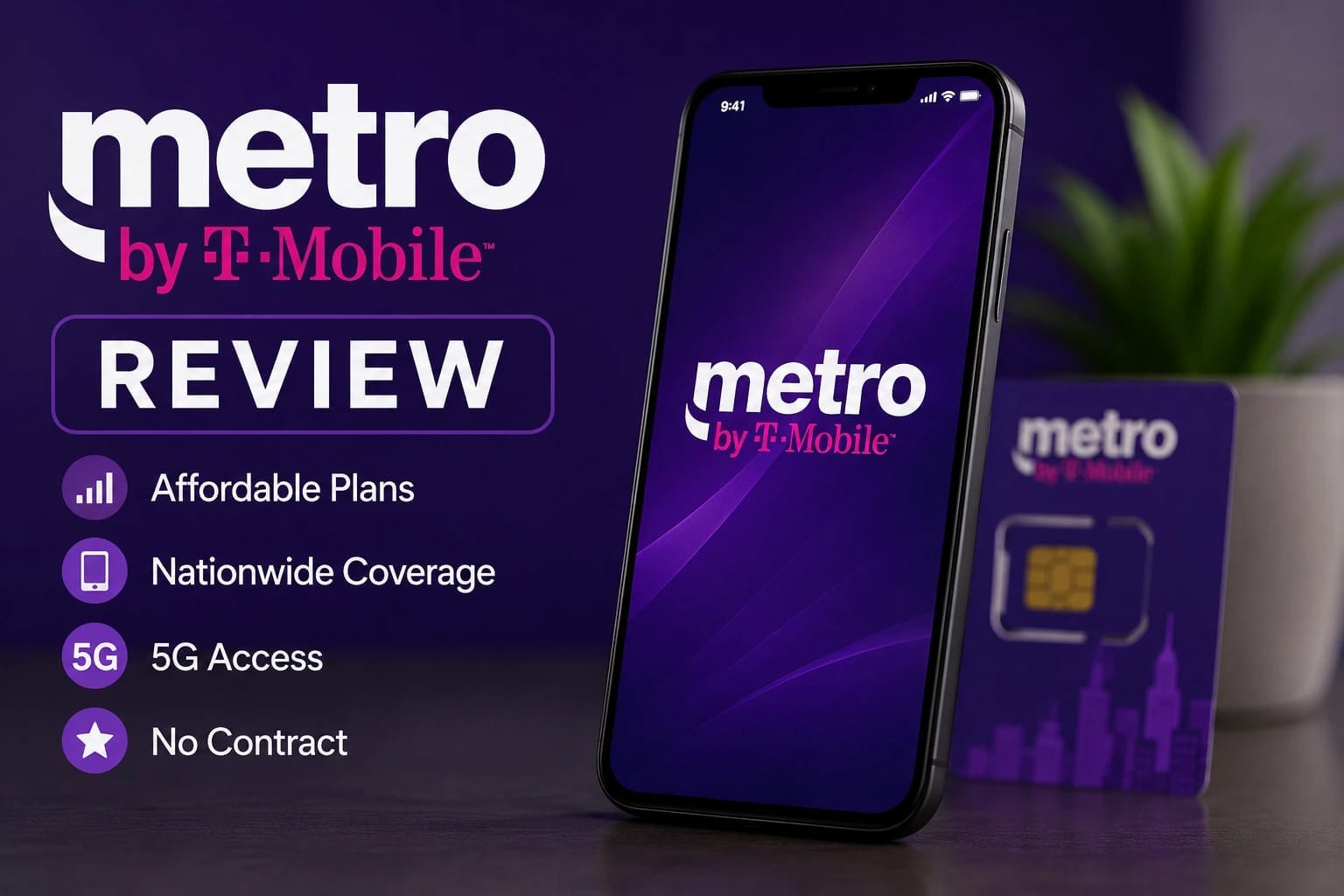
Metro by t-mobile reviews: It is a strong prepaid choice for people who want T-Mobile’s 5G network without a traditional postpaid contract. Its main strengths are straightforward pricing, broad 5G access, taxes included on many plans, and flexible prepaid service, while network prioritization and plan-specific limits are important drawbacks to understand.
Metro by T-Mobile Reviews and Overall Experience
Metro by T-Mobile reviews generally point to a simple value proposition: affordable prepaid wireless service running on T-Mobile’s network. Formerly known as MetroPCS, the carrier is designed for customers who want predictable service without committing to a traditional annual contract. Current plans include unlimited 5G options, multi-line pricing, hotspot allowances on selected plans, and a five-year price guarantee on eligible service.
The biggest question is not whether Metro offers modern mobile service—it does—but whether its combination of price, network access, data policies, and features fits your usage. For many budget-conscious users, Metro is compelling. For customers who regularly need the highest possible network priority, extensive international benefits, or premium postpaid extras, the calculation is less straightforward.
Key Specifications and Features
| Feature | Metro by T-Mobile details |
|---|---|
| Network | T-Mobile 4G LTE and 5G network |
| Service type | Prepaid wireless |
| Contract | No annual contract |
| 5G data | Available on qualifying plans |
| Price guarantee | Five years on eligible plans |
| Taxes and fees | Included on listed qualifying plans |
| Hotspot | Available on selected plans |
| International benefits | Available on selected plans |
| BYOD | Supported |
| eSIM | Supported on compatible devices |
| Phone upgrades | Included with eligible higher-tier plans |
| Scam protection | Scam Shield features |
| Multi-line plans | Available |
metro by t-mobile reviews: These details make Metro more than a basic low-cost carrier. The service is built around T-Mobile’s network infrastructure, so customers can access both 4G LTE and 5G coverage where available. Metro also supports bring-your-own-device activation, giving users a way to keep a compatible phone instead of purchasing another handset.
Metro by T-Mobile Reviews: Network and Coverage
Network coverage is one of Metro’s strongest selling points. Because Metro operates on T-Mobile’s network, customers can access the same broad underlying 4G LTE and 5G infrastructure. T-Mobile’s extensive 5G footprint makes Metro particularly attractive in cities and other areas where T-Mobile performs well.
However, saying Metro uses T-Mobile’s network does not mean Metro customers always receive exactly the same network experience as T-Mobile postpaid customers. Metro states that its speeds may be reduced compared with T-Mobile during congestion because of network prioritization. This distinction matters for heavy data users, especially when a local tower is busy.
Coverage also varies by location. Metro provides an official coverage map that distinguishes technologies such as 5G Ultra Capacity, Extended Range 5G, 4G LTE, and partner coverage. Checking the map for your home, school, workplace, and frequently visited areas is more useful than relying on a nationwide coverage claim alone.
Plans, Data, and Everyday Value
Metro’s current lineup gives customers several ways to balance price and features. Its website lists unlimited 5G plans at different price levels, including options with hotspot data and additional benefits. A higher-tier $60-per-month plan with AutoPay includes unlimited premium 5G data, 25GB of hotspot data, Amazon Prime, Google One storage, and other benefits.
Lower-priced plans can be attractive when the goal is simply reliable talk, text, and smartphone data. Metro also offers a six-month unlimited option for eligible new customers bringing their own phone, advertised at $120 upfront, equivalent to $20 per month. Because promotional eligibility and terms can change, customers should verify the current offer before purchasing.
One important consideration is network management. Metro’s current plan information says users on certain lower-priced unlimited plans may experience slower speeds when the network is busy after passing specified monthly data thresholds. That does not necessarily make the service poor; it simply means frequent high-volume users should choose their plan carefully.
Features That Improve the Experience
Metro includes several practical extras rather than focusing only on headline data allowances. Scam Shield provides tools such as caller identification and scam-call blocking, while T-Mobile Tuesdays gives qualifying Metro customers access to rotating promotional offers through the Metro app.
The availability of eSIM is another convenience for compatible devices. Customers can also bring an eligible existing phone, which can reduce the total cost of switching. For users who already own a recent unlocked device, BYOD can make Metro considerably more appealing because the main expense becomes the service plan rather than a new handset.
The five-year price guarantee is also notable. Metro says eligible customers receive a guarantee that the price of talk, text, and 5G smartphone data will not change for at least five years while they remain on an eligible plan. The guarantee has exclusions, so it should not be interpreted as a promise that every charge or add-on will remain unchanged.
Real-World User Experience and Testing Points
A useful Metro evaluation should focus on consistency rather than one impressive speed test. In everyday use, the important questions are whether calls remain dependable, websites load quickly, streaming works comfortably, and data performance stays acceptable in crowded locations.
Metro’s published broadband information for its plans lists typical 5G download ranges reaching hundreds of megabits per second, although actual performance varies with location, device, network traffic, signal conditions, and other factors. These figures should therefore be treated as reference information rather than a guarantee of what every customer will experience.
For testing, a prospective customer should compare performance in several places and at different times of day. A phone that performs well at home may behave differently at a busy shopping center, stadium, transit hub, or other crowded location. This is especially relevant for Metro because network congestion can affect customers differently from T-Mobile postpaid subscribers.
Voice calling and messaging are less demanding than intensive mobile data, so basic communication should not be judged solely through download speeds. Battery life is also primarily a phone characteristic rather than a Metro feature, although weak cellular signal can affect a handset’s battery consumption.
Pros and Cons of Metro by T-Mobile
Pros
- Access to T-Mobile’s extensive 4G LTE and 5G network.
- Straightforward prepaid service without an annual contract.
- Multiple plan levels for different budgets and data needs.
- Taxes and fees included on qualifying advertised plans.
- Five-year price guarantee on eligible plans.
- BYOD and compatible eSIM support.
- Useful extras such as Scam Shield and T-Mobile Tuesdays.
- Higher-tier plans can include substantial hotspot and entertainment benefits.
Cons
- Network speeds can be reduced during congestion compared with T-Mobile postpaid service.
- Coverage quality still depends heavily on the customer’s location.
- Lower-priced plans have fewer premium benefits.
- International features vary by plan and may require specific options.
- Some attractive offers have eligibility or promotional conditions.
- In-store activation or device changes can involve a fee on applicable plans.
Overall Quality
metro by t-mobile reviews: The strongest argument emerging from Metro by T-Mobile reviews is value rather than luxury. Metro combines prepaid flexibility with access to a major national 5G network, making it more substantial than many people might expect from a budget carrier.
Its main limitation is the trade-off between low-cost service and network priority. If your local T-Mobile coverage is strong and your usage fits the plan rules, Metro can provide a very competitive wireless experience. If you frequently consume large amounts of mobile data in congested areas, that trade-off deserves much more attention before switching.
Metro by T-Mobile Pricing and Availability
Metro by T-Mobile’s current pricing makes it competitive with other prepaid carriers, particularly for customers who want unlimited service without a traditional postpaid bill. Current 2026 listings show Metro plans ranging from lower-cost options to premium unlimited tiers, with the exact lineup and promotional pricing subject to change. One current comparison lists Metro’s plans from about $25 for qualifying BYOD service, while another current 2026 comparison lists its standard lineup from $40 to $65.
The difference between promotional, web-exclusive, BYOD, and standard plans is important. A particularly attractive offer may require bringing your own compatible phone, enrolling in AutoPay, paying several months in advance, or meeting other eligibility conditions. Metro currently advertises a six-month unlimited 5G option at $120 upfront for eligible customers, equivalent to $20 per month.
Metro is also widely available through physical retail stores as well as online channels. That gives it an advantage over online-focused prepaid brands when customers want help activating service, selecting a device, or resolving an account issue in person.
Before purchasing, check the exact plan terms, device compatibility, taxes and fees, activation requirements, and promotional conditions. This is especially important because prepaid wireless offers can change more frequently than the underlying network.
Metro by T-Mobile vs Mint Mobile
Mint Mobile is one of the most obvious alternatives because both brands operate on T-Mobile’s network. Mint can be particularly attractive to customers focused on keeping monthly costs low. Current 2026 comparisons list Mint plans starting around $15 per month, although its pricing structure can involve paying for multiple months in advance.
Metro has an important advantage for shoppers who value physical stores. Mint is primarily an online service, whereas Metro has a large retail presence. Metro also offers a broader selection of phone purchasing and in-person support options.
For a customer who already owns a compatible phone and is comfortable managing everything online, Mint may offer stronger pure-price value. For someone who prefers face-to-face assistance or wants to purchase a phone through a retail location, Metro can be the more convenient choice.
Metro by T-Mobile vs Visible
Visible uses Verizon’s network, making it a better alternative when Verizon has stronger coverage in your area. Current 2026 plan comparisons list Visible at around $25 per month for its basic unlimited offering, with higher-priced options providing additional features.
Metro has the advantage if T-Mobile coverage is stronger where you live and work. Visible can be compelling for customers who want Verizon-based unlimited service at a straightforward prepaid price. The decision should therefore begin with network coverage rather than simply choosing whichever advertised price looks lower.
Metro may also appeal more to customers who want physical retail support, while Visible emphasizes online account management.
Metro by T-Mobile vs Cricket Wireless
Cricket Wireless is another major prepaid competitor and uses AT&T’s network. The two services are similar in their prepaid structure, retail presence, family-plan approach, and availability of unlimited options. A June 2026 comparison lists both as contract-free prepaid providers with taxes and fees included on their advertised plans.
The most important difference is network. Metro relies on T-Mobile, while Cricket relies on AT&T. Cricket can therefore be the better choice for someone who receives stronger AT&T coverage, while Metro makes more sense for someone with stronger T-Mobile service.
Cricket can also be attractive for families. Its current lineup includes multi-line discounts, while Metro similarly offers discounts across multiple lines. The best option depends on the number of lines, required hotspot data, included perks, and local coverage.
Is Metro by T-Mobile Worth It?
Metro is worth considering when affordability, flexible prepaid service, and T-Mobile coverage are your priorities. It is particularly appealing for customers who do not want a long-term contract and want predictable wireless costs.
Its biggest weakness is that the cheapest plan is not automatically the best plan for every user. Heavy data users should examine premium-data rules and congestion policies carefully. Someone who spends a lot of time in crowded locations may notice slower performance when network traffic is high.
The same principle applies to hotspot use. If you regularly use your phone as a replacement for home internet, a plan with a larger hotspot allowance may be more appropriate than a cheaper unlimited plan with fewer hotspot benefits.
For ordinary calling, messaging, browsing, social media, navigation, and streaming, Metro can be a strong value when its network performs well in your area.
Frequently Asked Questions
Is Metro by T-Mobile a good carrier?
Yes, Metro can be a good carrier for budget-conscious customers who want prepaid service and access to T-Mobile’s 5G network. Its value is strongest when T-Mobile coverage is reliable in the customer’s area and the selected plan matches their data and hotspot requirements.
Does Metro by T-Mobile use T-Mobile’s network?
Yes. Metro operates using T-Mobile’s network infrastructure, including its 4G LTE and 5G networks. However, network management can mean Metro customers experience slower speeds than T-Mobile postpaid customers during periods of congestion.
Is Metro by T-Mobile cheaper than T-Mobile?
Metro is generally positioned as a lower-cost prepaid alternative to T-Mobile’s postpaid service. The exact savings depend on the plan, number of lines, promotional eligibility, and included benefits. Customers should compare the total features rather than price alone.
Can I bring my own phone to Metro?
Yes. Metro supports compatible bring-your-own-device phones. Customers should check their device’s compatibility before activating service. Compatible devices may also support eSIM, making activation more convenient.
Does Metro by T-Mobile have good 5G?
Metro provides access to T-Mobile’s 5G network, so performance can be excellent where T-Mobile has strong coverage. Actual speeds depend on location, device capability, signal strength, congestion, and the specific plan.
Who should avoid Metro by T-Mobile?
Metro may not be ideal for customers who regularly need maximum network priority in congested areas, extensive international features, or the broader premium benefits associated with expensive postpaid plans. It may also be less attractive if T-Mobile coverage is weak where the service will be used most.
More Information About Reviews, Please Visit Our Website: Apple Air Phone Camera Review: Is the iPhone Air Worth Buying?
Samsung Galaxy A56 Specifications: Features & Details
Huawei Pura 80 Ultra: Specs, Camera, Features & Review
Samsung Best Camera Phone: Top Galaxy Camera Phones
Huawei P30 Pro: Features, Performance, Camera and More
Best Budget Smartphones: Top Affordable Picks
iPhone 13 Pro Max Review: A Premium Apple Flagship in 2026
REDMAGIC 10S Pro Review: Is This Gaming Phone Worth It?
REDMAGIC 11 Pro Review: Is This Gaming Phone Worth Buying?
Conclusion
Metro by T-Mobile is a strong prepaid choice for users who want affordable plans, broad T-Mobile 5G access, and no long-term contract. Its biggest trade-off is network prioritization during congestion. If T-Mobile coverage is strong in your area and the plan fits your usage, Metro is well worth considering for reliable, budget-friendly wireless service.